Developing innovative capabilities for electric energy devices and systems
The Electrification and Energy Infrastructures Division targets breakthroughs to improve the reliability, versatility, and efficiencies of energy storage systems, electric grid protections and controls, power electronics, image and signal technologies, and advanced sensors.

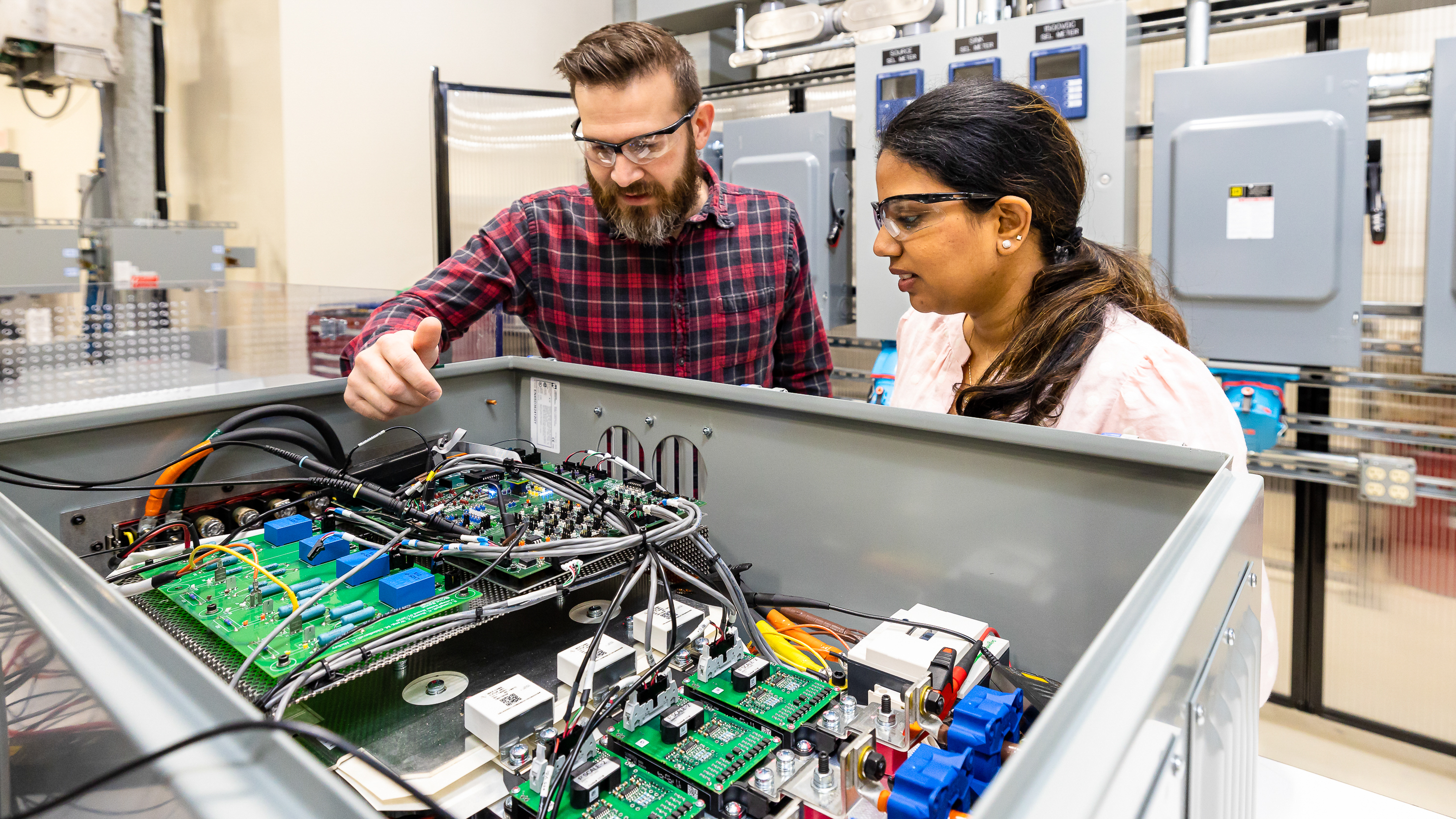
EEID utilizes and stewards the Grid Research Innovation and Development Center (GRID-C) at Oak Ridge National Laboratory. The 52,000-square-foot facility is a national showcase for energy systems research and development, enabling breakthroughs to support a resilient, reliable, and secure power grid. The unique, multipurpose research environment at GRID-C is available to industry, academic, and government partners who wish to access its state-of-the-art capabilities and world-class researcher expertise for developing innovative grid technologies.
Similarly, EEID hosts the country’s largest open-access battery manufacturing research and development center. The Battery Manufacturing Facility, co-located with GRID-C, provides scientists and industry with the ability to analyze every aspect of battery production, from raw materials to coin and pouch cell batteries to performance testing.
Technologies developed in EEID also support and protect vital communications and transportation infrastructure, domestic manufacturing, nuclear security, and defense readiness. Researchers develop imaging, sensing, and modeling algorithms and devices, often enhanced by machine learning, to provide real-time awareness for informed decision-making at a utility, in a factory, or in a national security environment.
Groups
Pioneers innovations – including demand response, innovative sensor technologies, advanced modeling techniques, and precise control mechanisms – to fortify security and reliability at the edge of the power grid and as it interfaces with commercial, residential and industrial buildings.
Group leader: Jamie Lian
Focuses on overall system architectures for distribution system networks that integrate supporting equipment such as power electronics, while incorporating communication, controls, optimization and algorithms that can be tested in simulation and real-time platforms, including hardware -in-the-loop and full hardware systems.
Group leader: Joao Pereira Pinto
Designs and develops power electronic solutions for interfacing with the next-generation sources and loads in the electric grid, encompassing converter architectures, controls, magnetics, and test beds.
Group leader: Prasad Kandula
Researches and develops new grid mathematics, modeling techniques, and control methods to reveal emerging power grid transients and dynamics, to analyze impacts of power electronics, and to enhance modernized grid stability.
Group leader: Yaosuo Xue
Leverages expertise in real-time monitoring, data analytics, sensing, advanced relays, adaptive protection systems, and large-scale modeling of energy system interactions and electromagnetic transient faults to support a resilient and secure electric grid.
Group leader: Nils Stenving
Conceives, researches and develops disruptive chemistries and materials for high-energy and power-dense solid-state batteries and emerging electrochemical storage systems.
Group leader: Mali Balasubramanian
Develops advanced processes, manufacturing schemes and pilot scale devices in energy storage and conversion research, from materials synthesis through characterization, electrode engineering, cell prototyping, and product performance testing.
Group leader: Jaswinder Sharma
Develops advanced processes, manufacturing schemes and pilot scale devices in energy storage and conversion research, from materials synthesis through characterization, electrode engineering, cell prototyping, and product performance testing.
Group leader: Nance Ericson
Focuses on integrated sensing and communication platforms for energy applications, including the development and testing of multi-parameter sensing systems, advanced signal processing and machine learning algorithms, cybersecurity, and grid communications architecture solutions.
Group leader: Ali Ekti
Designs and develops algorithms and systems that fuse computational sensing approaches to images and signals, often incorporating applied artificial intelligence, sensing, signal processing, computer vision, and tomographic reconstruction.
Group leader: Joel Brogan
Develops low-power sensing systems, algorithms and modeling approaches – often incorporating AI – for understanding and monitoring the security and health of critical infrastructure, with expertise to tackle challenges in complex wireless communications environments and emerging signal processing problems.
Group leader: Corey Cooke
Facilities