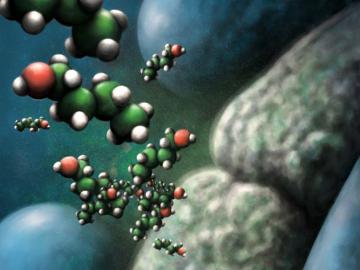
Scientists at ORNL and the University of Cincinnati achieved a breakthrough in understanding the vulnerability of microbes to the butanol they produce during fermentation of plant biomass.


Scientists at ORNL and the University of Cincinnati achieved a breakthrough in understanding the vulnerability of microbes to the butanol they produce during fermentation of plant biomass.

Hugh O’Neill’s lifelong fascination with the complexities of the natural world drives his research at ORNL, where he’s using powerful neutron beams to dive deep into the microscopic realm of biological materials and unlock secrets for better production

Revealing differences in fundamental structural and dynamical effect of ergosterol on a major eukaryotic model membrane (POPC) from those of cholesterol.
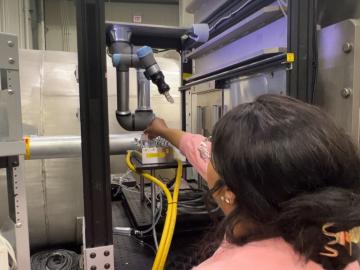
The BIO-SANS instrument, located at Oak Ridge National Laboratory’s High Flux Isotope Reactor, is the latest neutron scattering instrument to be retrofitted with state-of-the-art robotics and custom software.

Evidence for lignin–carbohydrate complexes (LCCs) formed between lignin and pectin was obtained by synthesis and biophysical characterization of deuterated lignin–pectin composites.

This is the first work to unveil the self-assembly of proteins through adsorbate-adsorbate interactions across pore apertures of a metal-organic framework (MOF) via small-angle neutron scattering (SANS).
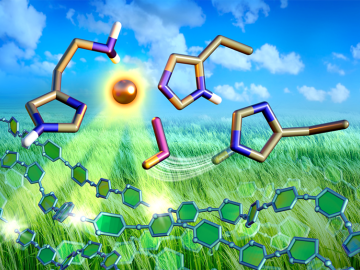
Nonfood, plant-based biofuels have potential as a green alternative to fossil fuels, but the enzymes required for production are too inefficient and costly to produce.
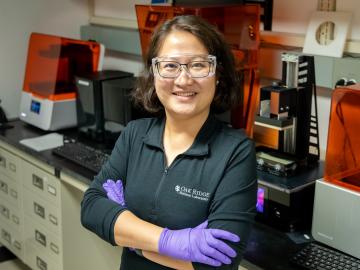
Growing up in China, Yue Yuan stood beneath the world’s largest hydroelectric dam, built to harness the world’s third-longest river.
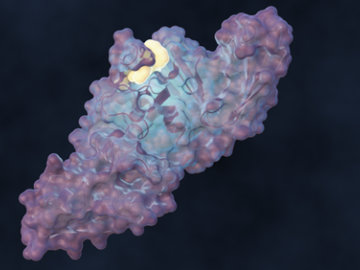
A team of scientists led by the Department of Energy’s Oak Ridge National Laboratory designed a molecule that disrupts the infection mechanism of the SARS-CoV-2 coronavirus and could be used to develop new treatments for COVID-19 and other viral disease

It is shown that presence of dodecylmaltoside (DDM) detergent changes lipid bicelle self-assemblies from anisometric geometry to less ordered, smaller-dimensioned and more isometric self-assemblies.