
The visit to ORNL sought to establish further collaboration with U.S. national labs and other partners to help build up Signapore's nuclear energy capabilities.


The visit to ORNL sought to establish further collaboration with U.S. national labs and other partners to help build up Signapore's nuclear energy capabilities.

ORNL set a new milestone in nuclear component innovation, successfully testing two 3D-printed stainless steel experimental capsules at the lab’s High Flux Isotope Reactor.
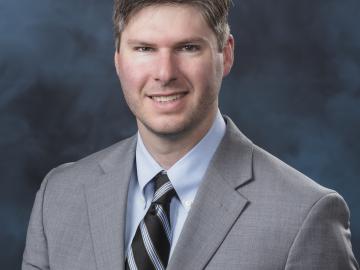
Capps is being recognized for his leadership in advancing the safe and economic expansion of nuclear power by leveraging advanced modeling and simulation to facilitate accelerated testing and licensing of high burnup and accident-tolerant fuel, represen

The Department of Energy’s Oak Ridge National Laboratory hosted a delegation of Italian energy officials and leaders from April 7 through 15, spotlighting a shared commitment to innovation and international partnership in advanced nuclear and fusion ene
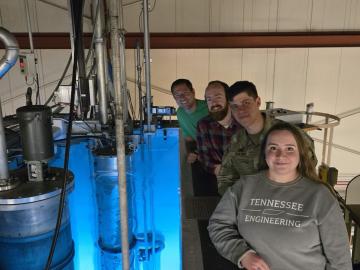
A team from ORNL, joined by university students, recently traveled to the Ohio State University Research Reactor to conduct a novel experiment on nuclear thermal rocket fuel coatings — one that could help propel NASA’s astronauts to Mars faster and more

The symposium was coordinated as part of the DOE Office of International Nuclear Energy Policy and Cooperation efforts to launch Regional Energy Training Centers in new-to-nuclear countries.
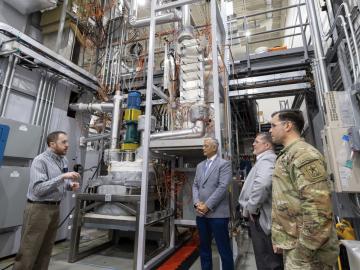
During a recent visit to ORNL, several OASA (IE&E) representatives explored the ORNL’s leadership in advanced nuclear energy development to inform the design and construction of a microreactor to power mission-critical facilities at two Army bases.&
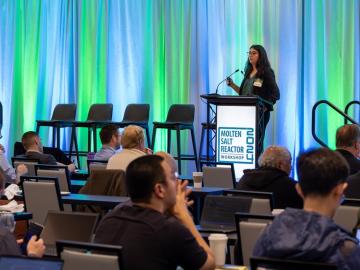
ORNL’s annual workshop has become the premier forum for molten salt reactor, or MSR, collaboration and innovation, convening industry, academia and government experts to further advance MSR research and development.

FREDA is a new tool being developed at ORNL that will accelerate the design and testing of next-generation fusion devices.

The American Nuclear Society has recognized Arnold Lumsdaine and Walid Metwally, group leaders within the Fusion and Fission Energy and Science Directorate at ORNL, with ANS Presidential Citations.