Advancing materials qualification for the future of nuclear energy.
ORNL’s Fuel Cladding and Core Internals (FCCI) Group is accelerating nuclear materials qualification by developing, testing, and characterizing advanced materials across different reactor and irradiation conditions, to validate accelerated approaches to developing and qualifying new fuels and materials with greater confidence.
The materials inside nuclear reactors, like fuel cladding and structural components, must perform reliably for years or even decades in extreme conditions. Qualifying these materials for safe and efficient use can take just as long, slowing innovation as reactor technologies evolve and nuclear energy demand increases.
A trusted partner across the nuclear industry, the FCCI group leverages a combined expertise in manufacturing, materials science, and radiation effects to generate fundamental data on how nuclear materials evolve and behave across conditions, and how those changes affect their microstructure and the resulting material performance.
The group’s expansive insight helps validate material performance models by focusing on the classical synergies and combined effects of materials, coolants, stress, and radiation to accelerate the technology transition to industry stakeholders.
World-class capabilities in nuclear materials science
Situated across the ORNL campus, the FCCI group has access to the Lab’s world-class facilities and capabilities, including:
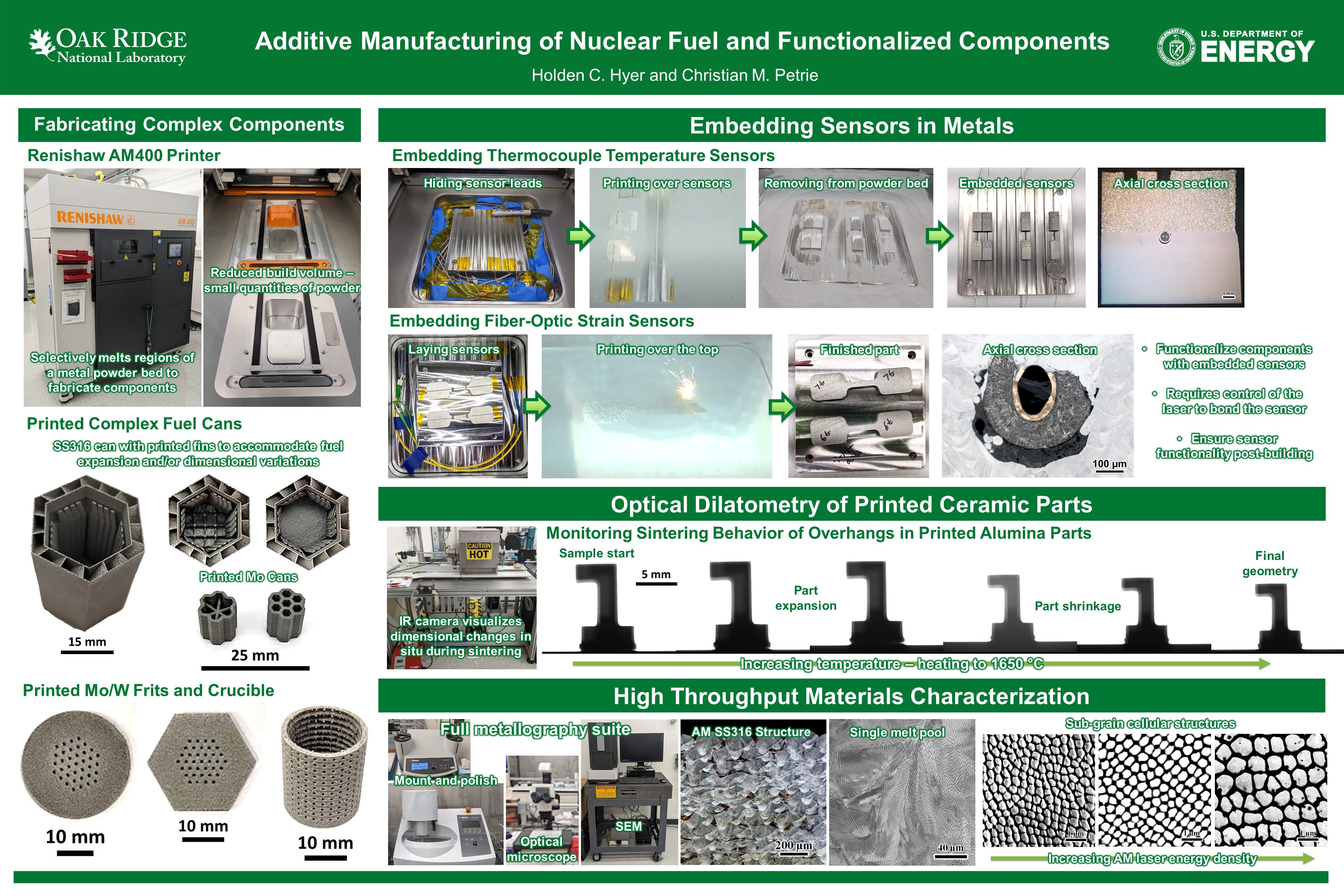
- The newly developed NuPrint Lab and the Manufacturing Demonstration Facility for both conventional and additive manufacturing
- The High Flux Isotope Reactor (HFIR), offering the world’s highest steady-state neutron flux
- Several hot cells and radiological facilities for the advanced characterization of irradiated materials
- In situ monitoring technologies, including embedded fiber optic sensors, for real-time performance insights during manufacturing and operation
Accelerating industry readiness through collaborative projects
The FCCI Group is a key contributor to several DOE programs and industry partnerships, reflecting the group’s leadership in fundamental and applied nuclear science:
- Accident Tolerant Fuel Qualification: Performing post-irradiation examination of fuels irradiated in commercial reactors, in addition to accelerating qualification of cladding materials and concepts using HFIR in collaboration with GE, General Atomics, Westinghouse, and Framatome
- LWR Fuel Burnup Extension: The FCCI group is an international leader in safety testing of commercial fuels under loss of coolant accident scenarios.
- Accelerated Material Qualification: Using a combination of ion and neutron irradiation, modeling and simulation, and surveillance programs to reduce the time/cost to qualify structural materials.
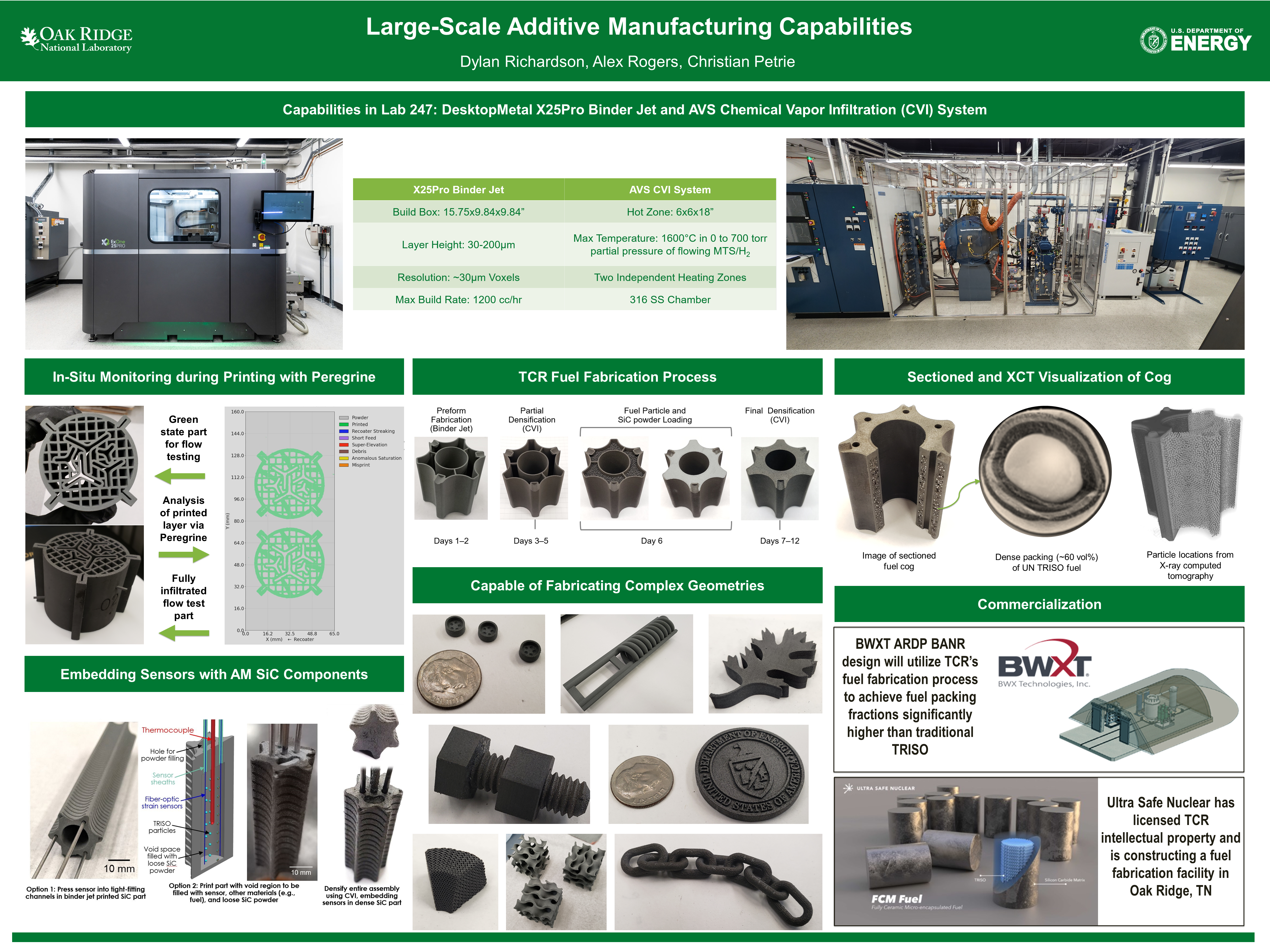
- Advanced Reactor Demonstration Programs (ARDPs): Leading post-irradiation examination and advanced manufacturing activities supporting Kairos Power’s demonstration reactors, SiC additive manufacturing for BWXT, and supporting Fe- and V-alloy work under the TerraPower ARDP.
Mission-driven research to support U.S. nuclear energy goals
The FCCI Group is enhancing the reliability and economics of LWRs and the deployment of advanced reactors, as demonstrated through recent milestones, including:
- Developing and executing on the industry consensus loss-of-coolant accident and time-at-temperature test plans in support of burnup extension and power uprates
- Completing the first-ever liquid-metal bonded MiniFuel irradiation in HFIR
- Performing post-irradiation examinations performed on laser powder bed fusion 316H stainless steel
- Completing the first post-irradiation evaluation of radiation-induced bowing of long SiC/SiC composite fuel cladding under intentional neutron flux gradients
- Developing alloys for new high strength cladding compositions for LWRs and microreactors
- Leading ASTM standard revisions for rapid qualification of core structural materials
- Deploying embedded sensor technology and complex hot cell fixtures fabricated via additive manufacturing
- Executing the first loss of coolant accident test on commercial accident tolerant fuel
Building toward long-term nuclear technology.
To meet the nuclear industry’s evolving needs, the FCCI Group leverages ORNL’s unique capabilities to develop faster, more efficient pathways for qualifying new fuels and materials. In collaboration with national labs, industry, and regulators, the team is pushing the limits of current LWR fuel and cladding, advancing 3D-printed components, further development and standardization of testing methodologies, and designing stronger, more radiation-tolerant cladding—driving innovation for the next generation of nuclear energy.