

ORNL's Communications team works with news media seeking information about the laboratory. Media may use the resources listed below or send questions to news@ornl.gov.
1 - 10 of 525 Results

Electrolytes that convert chemical to electrical energy underlie the search for new power sources with zero emissions. Among these new power sources are fuel cells that produce electricity.

Stephen Kowalski and Mikael Salonvaara received the Distinguished Service Award, which salutes members who have served the society with distinction in chapter, regional and society activities.

Three transportation researchers at the Department of Energy’s Oak Ridge National Laboratory have been elevated to senior member grade of the Institute of Electrical and Electronics Engineers, or IEEE.

Kashif Nawaz, distinguished researcher and section head for Building Technologies Research at the Department of Energy’s Oak Ridge National Laboratory, has been named a Fellow of the American Society of Mechanical Engineers, or ASME.
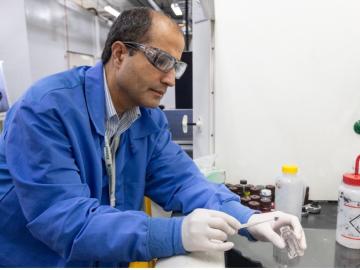
Electric vehicles can drive longer distances if their lithium-ion batteries deliver more energy in a lighter package. A prime weight-loss candidate is the current collector, a component that often adds 10% to the weight of a battery cell without contributing energy.
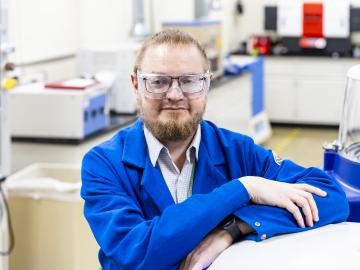
It would be a challenge for any scientist to match Alexey Serov’s rate of inventions related to green hydrogen fuel. But this researcher at ORNL has 84 patents with at least 35 more under review, so his electrifying pace is unlikely to slow down any time soon.
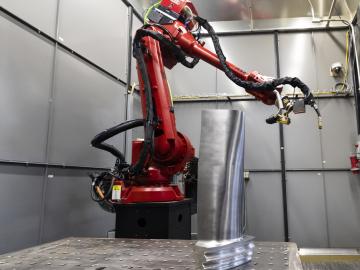
Researchers at ORNL became the first to 3D-print large rotating steam turbine blades for generating energy in power plants.
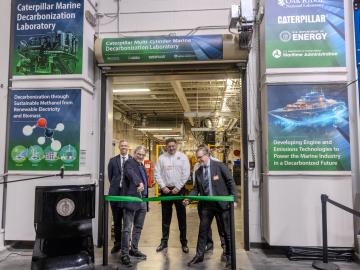
ORNL and Caterpillar Inc. have entered into a cooperative research and development agreement, or CRADA, to investigate using methanol as an alternative fuel source for four-stroke internal combustion marine engines.
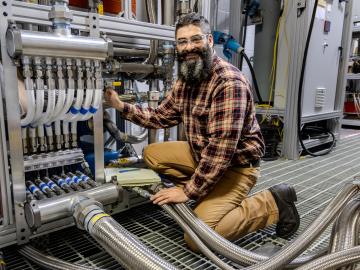
Within the Department of Energy’s National Transportation Research Center at ORNL’s Hardin Valley Campus, scientists investigate engines designed to help the U.S. pivot to a clean mobility future.
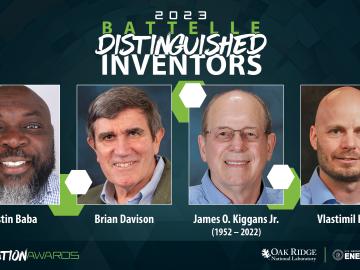
Four scientists affiliated with ORNL were named Battelle Distinguished Inventors during the lab’s annual Innovation Awards on Dec. 1 in recognition of being granted 14 or more United States patents.