

ORNL's Communications team works with news media seeking information about the laboratory. Media may use the resources listed below or send questions to news@ornl.gov.
1 - 10 of 180 Results

Using a best-of-nature approach developed by researchers working with the Center for Bioenergy Innovation at the Department of Energy’s Oak Ridge National Laboratory and Dartmouth University, startup company Terragia Biofuel is targeting commercial biofuels production that relies on renewable plant waste and consumes less energy. The technology can help meet the demand for billions of gallons of clean liquid fuels needed to reduce emissions from airplanes, ships and long-haul trucks.
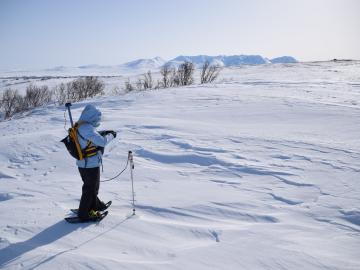
Researchers led by Oak Ridge National Laboratory have been criss-crossing the Alaskan tundra for 12 years, collecting data as part of the Next-Generation Ecosystem Experiments in the Arctic project, or NGEE Arctic. They’re tracking rapid changes in the land as temperatures rise.

Daryl Yang is coupling his science and engineering expertise to devise new ways to measure significant changes going on in the Arctic, a region that’s warming nearly four times faster than other parts of the planet. The remote sensing technologies and modeling tools he develops and leverages for the Next-Generation Ecosystem Experiments in the Arctic project, or NGEE Arctic, help improve models of the ecosystem to better inform decision-making as the landscape changes.
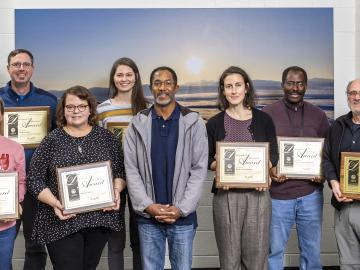
ORNL Environmental Sciences Division Director Eric Pierce presented the division’s 2023 Distinguished Achievement Awards at the organization’s December all-hands meeting.
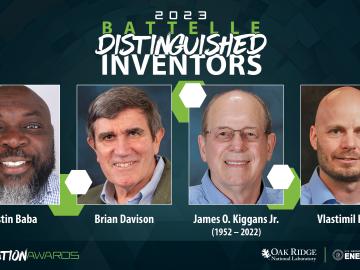
Four scientists affiliated with ORNL were named Battelle Distinguished Inventors during the lab’s annual Innovation Awards on Dec. 1 in recognition of being granted 14 or more United States patents.
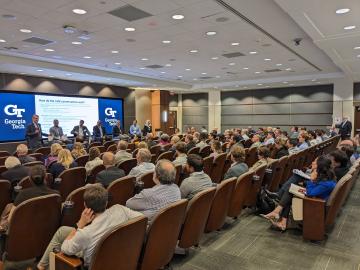
ORNL's Climate Change Science Institute and the Georgia Institute of Technology hosted a Southeast Decarbonization Workshop in November that drew scientists and representatives from government, industry, non-profits and other organizations to

Scientists at ORNL used their knowledge of complex ecosystem processes, energy systems, human dynamics, computational science and Earth-scale modeling to inform the nation’s latest National Climate Assessment, which draws attention to vulnerabilities and resilience opportunities in every region of the country.
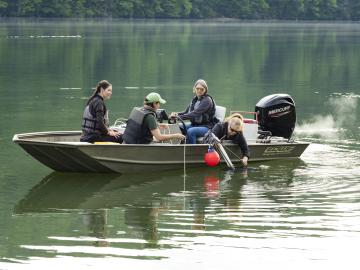
Griffiths and her colleagues are examining how much methane and carbon dioxide is released from the reservoir. Their aim is to better understand and predict how much of these climate-warming gases are coming from reservoirs across the nation.
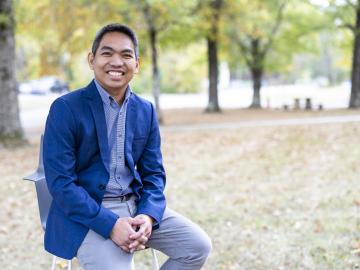
While completing his undergraduate studies in the Philippines, atmospheric chemist Christian Salvador caught a glimpse of the horizon. What he saw concerned him: a thin, black line hovering above the city.

Scientists at ORNL used their expertise in quantum biology, artificial intelligence and bioengineering to improve how CRISPR Cas9 genome editing tools work on organisms like microbes that can be modified to produce renewable fuels and chemicals.