
The Department of Energy announced a $67 million investment in several AI projects from institutions in both government and academia as part of its AI for Science initiative. Six ORNL-led (or co-led) projects received funding.


The Department of Energy announced a $67 million investment in several AI projects from institutions in both government and academia as part of its AI for Science initiative. Six ORNL-led (or co-led) projects received funding.

In an impressive showcase of cutting-edge innovation and scientific prowess, ORNL has been recognized as a beacon of technological excellence, receiving 14 R&D 100 Awards, announced this week by R&D World magazine.

Power companies and electric grid developers turn to simulation tools as they attempt to understand how modern equipment will be affected by rapidly unfolding events in a complex grid.
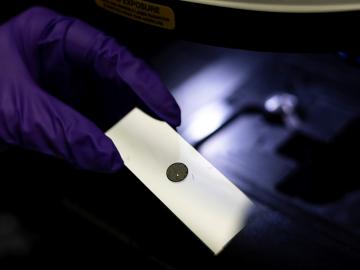
Nuclear nonproliferation scientists at ORNL have published the Compendium of Uranium Raman and Infrared Experimental Spectra, a public database and analysis of structure-spectral relationships for uranium minerals.
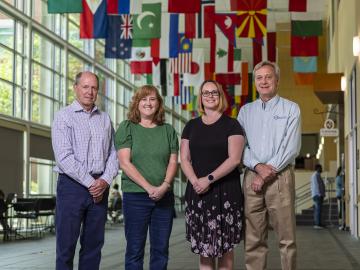
For 25 years, scientists at Oak Ridge National Laboratory have used their broad expertise in human health risk assessment, ecology, radiation protection, toxicology and information management to develop widely used tools and data for the U.S.

Autonomous labs are changing the nature of scientific investigation. Instead of humans manually orchestrating every part of an experiment, programmed equipment can carry out necessary functions.

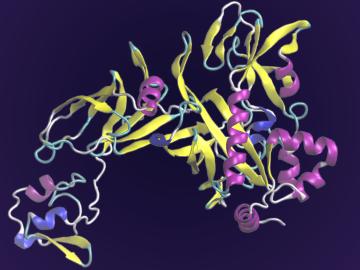
A team of scientists led by the Department of Energy’s Oak Ridge National Laboratory and the Georgia Institute of Technology is using supercomputing and revolutionary deep learning tools to predict the structures and roles of thousands of proteins with

David Dean, director of the Quantum Science Center headquartered at the U.S.

A team led by Oak Ridge National Laboratory scientists will receive a $6 million federal grant to design a more efficient form of artificial intelligence that fits on a microchip.