Accelerating American Innovation
AI-driven projects for national scientific challenges
ORNL is taking a central role in the Genesis Mission, leading nine projects and contributing to 32 more that apply AI and advanced computing to some of the nation’s most complex scientific challenges. From fusion energy and critical minerals to water forecasting, advanced materials and autonomous science, these efforts are designed to move promising ideas into practical scientific capabilities with broad national impact.



ORNL-led projects
Phase I

AI-assisted fusion power plant designs
Developing an AI platform that will integrate high-performance computing tools and robotic system design.

Low-energy AI for scientific discovery
Analyzing scientific data at unprecedented rates and scales with lower costs and higher speeds than conventional AI while maintaining equivalent accuracy.
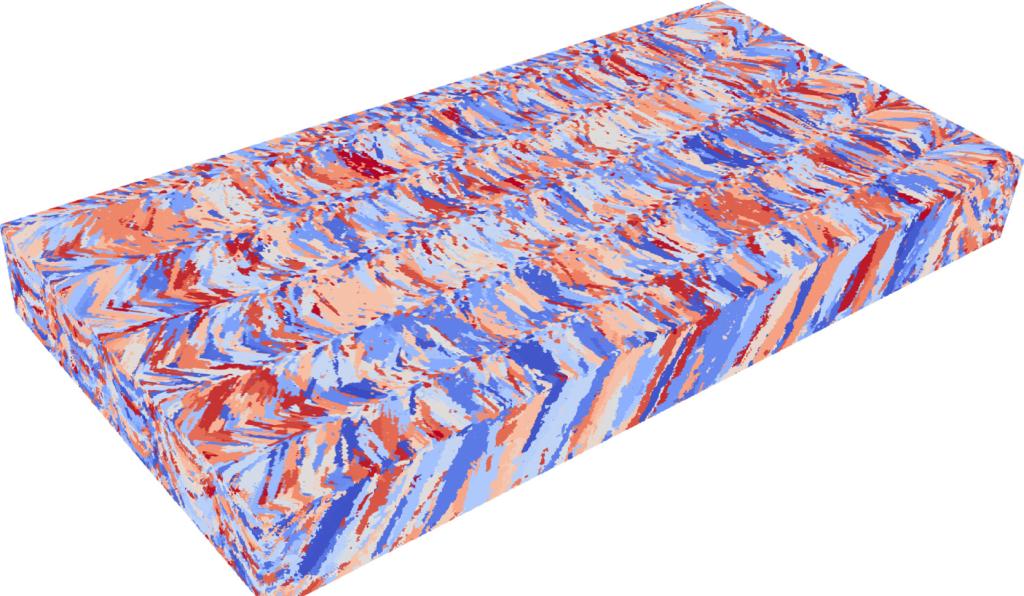
AI-accelerated materials development and advanced manufacturing applications
AI-based “foundation model factory” that will create custom foundation AI models that U.S. industry can leverage

AI-enabled discovery of rare earth elements
Improving predictions of underground deposits of materials essential for energy technologies, advanced manufacturing and national supply chain security.
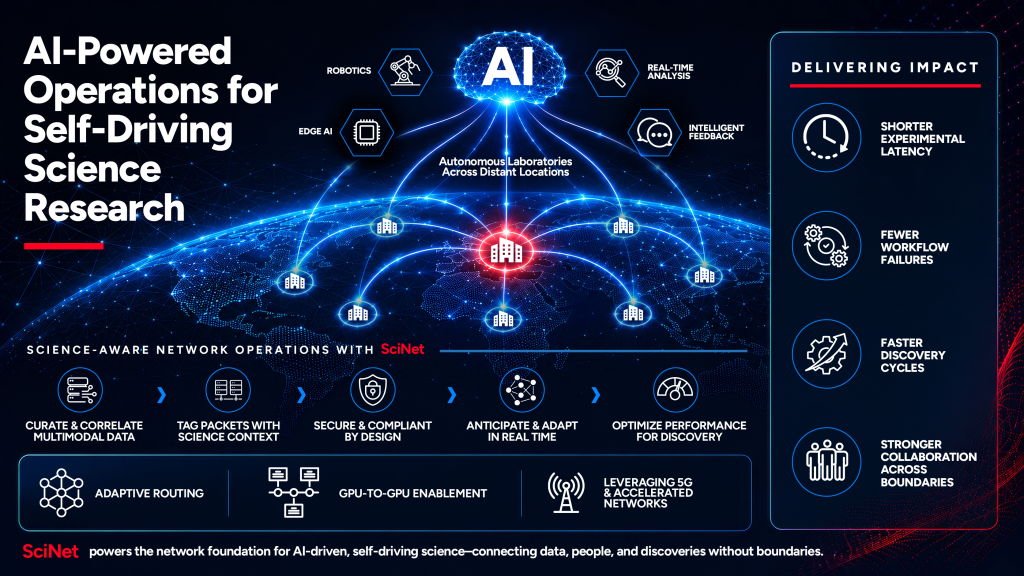
AI-powered operations for self-driving science research
Analyzing scientific data at unprecedented rates and scales with lower costs and higher speeds than conventional AI while maintaining equivalent accuracy.
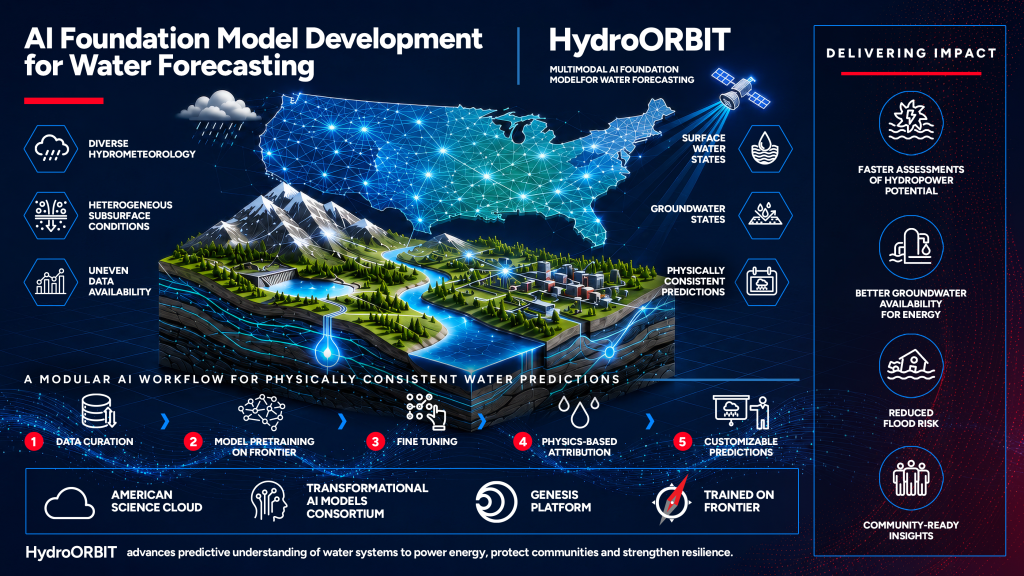
AI foundation model development for water forecasting
Improving prediction of surface and groundwater systems across the continental U.S.

AI-enabled subsurface biogeochemical modeling
Increasing understanding of underground biogeochemical cycles that affect the availability of resources such as critical minerals.

AI for long-range water prediction
Forecasting water availability, streamflow and river temperature weeks to years in advance, supporting hydropower and thermoelectric operations in the Tennessee Valley Authority region.
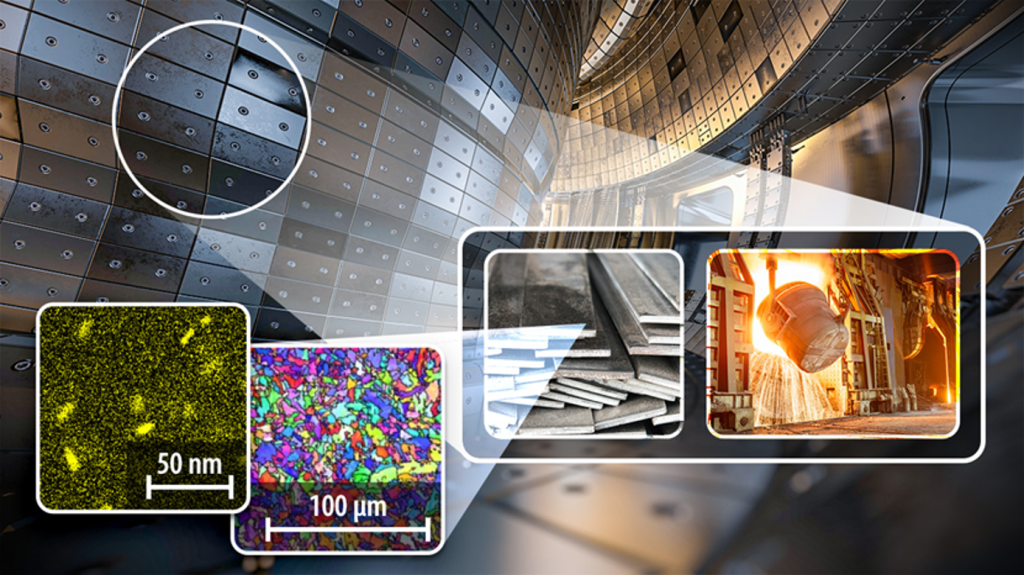
AI for next-generation fusion materials development
Linking processing, microstructure and performance that will accelerate deployment of next-generation structural alloys for reliable operation in nuclear fusion power plants.
Phase II
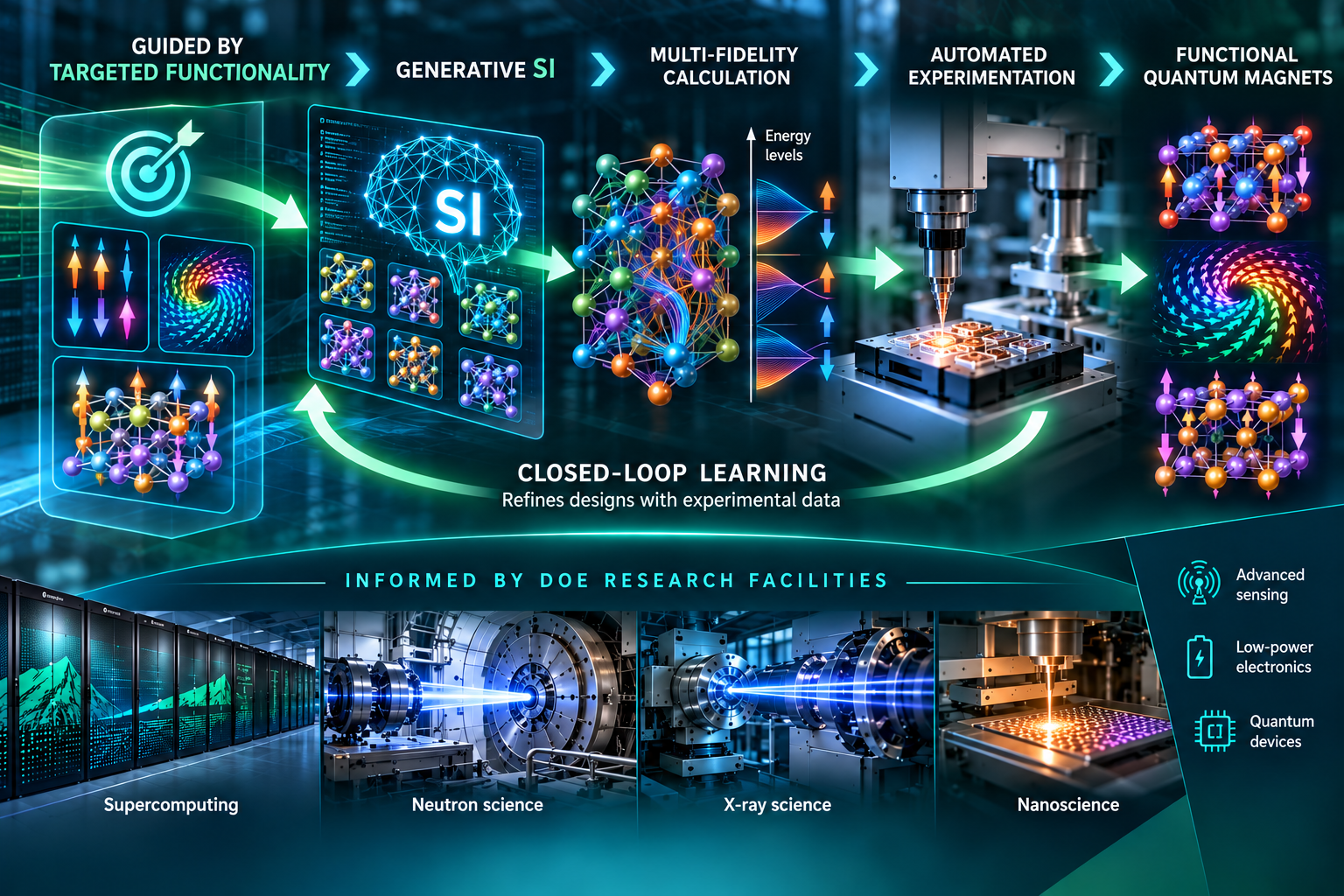
AI-empowered design of functional quantum magnets
Physics‑informed AI framework for the inverse design of quantum magnets with targeted properties
Collaborations
Phase I
AI Predictions for Safer, Higher-Performance Nuclear Reactor Control
Reactor Exhaust And Core Twin — Multi-fidelity AI Predictions for Safe, Integrated, and High-Performance Control
Fuel Cladding and Core Internals
Physics Informed Transformer Foundation Model with Uncertainty Quantification for Coupled Eulerian and Lagrangian Flow Physics (PIT-FM)
AI Forecasting of Seasonal and Long-Term Water Conditions
An Agentic AI Framework for Seasonal-to-Interannual U.S. Water Prediction: Coupling Large AI-based Prediction Models and Wavelet Diffusion with E3SM
AI Coordination of Advanced Manufacturing Simulations
Agentic HPC Pipeline Initiative: AI-Driven Orchestration of DOE Lab Codes for Advanced Manufacturing
Machine Learning for Engineering Microbial Gene Transfer
Machine-learning Optimization of Biological Interfaces for Lateral gene Exchange PATHways
AI Predictions of Material Fatigue and Structural Lifespan
A Material Agnostic Physics-Aware, Interpretable AI Framework for Fatigue Life Prediction in TPMS Structures
Real-Time AI Control of Fusion Energy Systems
Weak-Form Agentic Digital Twins for Real-Time Control of Magnetically Confined Fusion Systems Under Sparse Observation
Faster Nuclear Data Analysis Using AI
Accelerating Nuclear Data Delivery Using AI/ML approaches in High Complexity Data Sets
Adaptive AI for Automated Chemical Manufacturing
Closed-Loop, Efficient, Adaptive, and Robust AI for Agentic Chemical Manufacturing
Physics-Enhanced AI Discovery of Unconventional Superconductors
Physics-Enhanced AI Framework for Discovering New Classes of Unconventional Superconductors
Tracing Cybersecurity Threats Across Scientific AI Workflows
Scientific Provenance-Oriented Threat Tracing and Attribution for Genesis Workflows
AI Modeling of Subsurface and Reservoir Systems
Molecular-to-Reservoir Integrated AI for Coupled Landscape and Earth-system Subsurface Intelligence
AI Modeling of Reservoir and Groundwater Interactions
Reservoir-Groundwater Interactions for River Flow Variability, Energy, and Resilience with AI
AI-Accelerated Nuclear Astrophysics Simulations
Enabling Nuclear Astrophysics Computational Transformation with AI
AI Discovery of Advanced Semiconductor Materials and Interfaces
From Edisonian Optimization to Predictive Molecular Design: AI-Driven Discovery and Engineering of Advanced Semiconductor Interfaces
AI Platforms for Accelerating 2D Materials Development
AI-Orchestrated Multimodal Platforms for Accelerated Discovery, Scale-Up, and Deployment of 2D Materials
AI Modeling of Complex Turbulent Energy Flows
Differentiable Physics-Integrated Generative Modeling for Complex Turbulent Flows in DOE Energy Systems
AI Optimization of High-Performance Computing Applications
An End-to-End AI Framework for Performance Prediction and Optimization in HPC Applications
Recovering Rare Earth Elements with Magnetic Sorbents
Selective Recovery of Light and Heavy Rare-Earth Element Pairs via Functionalized Magnetic Sorbents with Induction-Assisted Regeneration
AI Tools for Improving Supercomputing Workloads
Using AI to Standardize and Systematically Advance HPC Workloads
AI Discovery of Rare Scientific Events
Enabling Rare Event Discovery with Surrogate Modeling and Simulation AI Agents
Phase II
AI‑enabled Digital Twin Platform for SPARC
Delivering an AI-enabled digital twin to support and accelerate tokamak operations
The Multi-Office Accelerator Team Core (MOAT-Core)
Cross‑facility agentic workflows that connect data, tools, and expert knowledge
AI-extended Interfacial Separations (AXIS)
Closed‑loop design of redox‑active ligands for reversible, electrically controlled separations
An Iterative Framework for AI-Assisted Scientific Software Development and Optimization (AI4HPC)
Creating an AI framework to modernize, optimize, and verify supercomputing scientific software
Accelerating eXtreme Environment Specs-to-Silicon (AXESS)
Designing high-performance microchips capable of operating in extreme conditions such as space, high-radiation, and ultra-cold environments
Advancing AI for nuclear energy through Prometheus
Integrated AI platform for faster nuclear energy deployment