Physics‑informed AI framework for the inverse design of quantum magnets with targeted properties
Designing magnetic materials by human-driven trial and error can be a slow process. However, a physics‑guided AI approach could significantly shorten the path from concept to material, accelerating the development of devices that use less power and operate with higher precision.
Specifically, this project, led by Yongqiang (YQ) Cheng at ORNL, will use artificial intelligence to help design new quantum magnetic materials. The aim is to connect materials’ structure and electronic properties to the fundamental interactions that govern magnetic spins. With this information, the team can predict magnetic behavior and design materials with targeted functionalities for sensing devices, low‑power electronics, and future quantum devices.
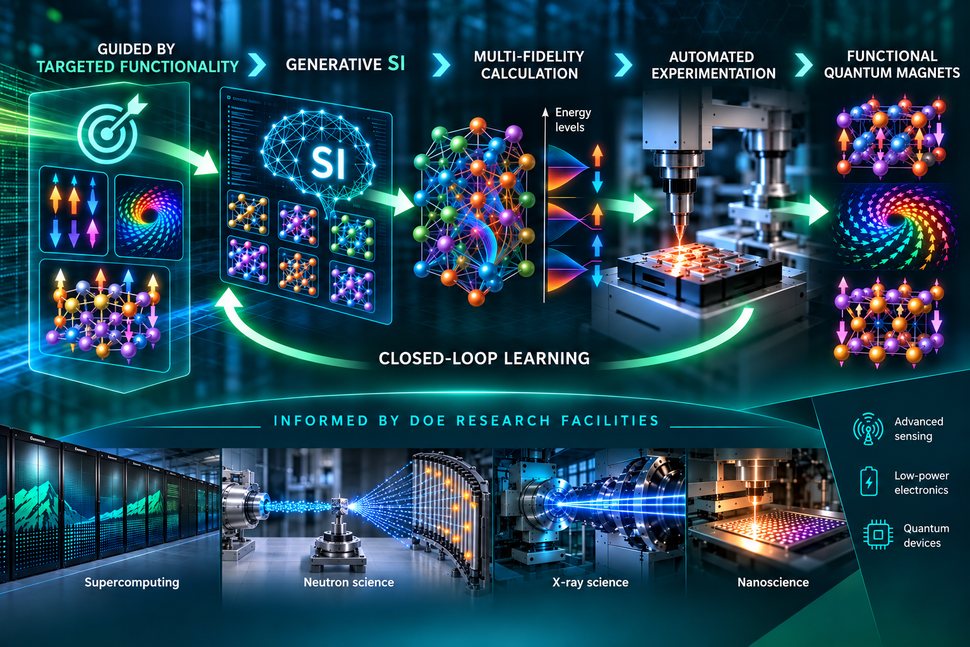
Researchers will use generative AI to identify promising crystal structures, evaluate them using high-fidelity simulations, and synthesize and characterize selected samples through AI-enabled, closed‑loop experiments. By tying prediction, synthesis, and characterization together, this workflow can expedite searches for targeted quantum states, including altermagnets, odd‑parity magnets, and topological magnets. The development and refinement of this AI framework will leverage DOE research facilities across supercomputing, neutron, X‑ray, and nanoscience.