

ORNL's Communications team works with news media seeking information about the laboratory. Media may use the resources listed below or send questions to news@ornl.gov.
1 - 10 of 81 Results
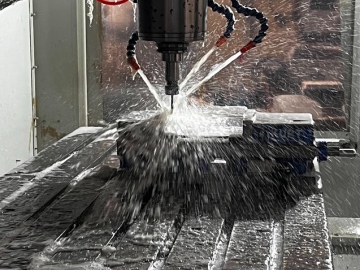
On Feb. 15, 2024, the one billionth item, also known as an “occupancy,” was scanned at the Port of Aqaba, Jordan, one of the early sites where radiation detection equipment was installed. This milestone shows the extent of countries committed to preventing the spread of radioactive material through the amount of data volunteered to ORNL for continuous improvement. As adversaries push the limits of smuggling dangerous material, this collaboration pushes back through science-backed analysis.
The National Security Sciences Directorate within the Department of Energy’s Oak Ridge National Laboratory has signed a memoranda of understanding with Jackson State University and with Tennessee Tech University. The MOUs detail ORNL’s intention to work with each university to enhance research and educational opportunities in nuclear science and engineering.
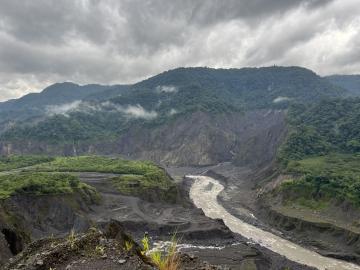
ORNL drone and geospatial team becomes first to map the Coca River in the Amazon basin as erosion and sediment threaten Ecuador’s lands.
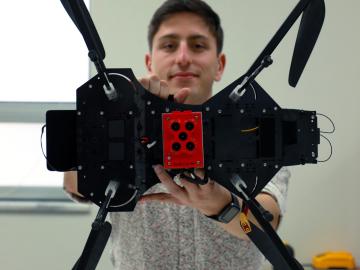
Jack Orebaugh, a forensic anthropology major at the University of Tennessee, Knoxville, has a big heart for families with missing loved ones. When someone disappears in an area of dense vegetation, search and recovery efforts can be difficult, especially when a missing person’s last location is unknown. Recognizing the agony of not knowing what happened to a family or friend, Orebaugh decided to use his internship at the Department of Energy’s Oak Ridge National Laboratory to find better ways to search for lost and deceased people using cameras and drones.

Digital twins are exactly what they sound like: virtual models of physical reality that continuously update to reflect changes in the real world.
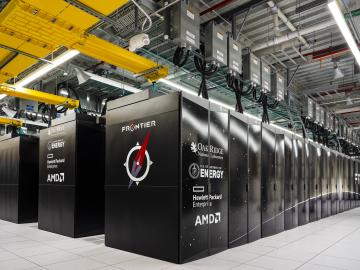
ORNL is home to the world's fastest exascale supercomputer, Frontier, which was built in part to facilitate energy-efficient and scalable AI-based algorithms and simulations.
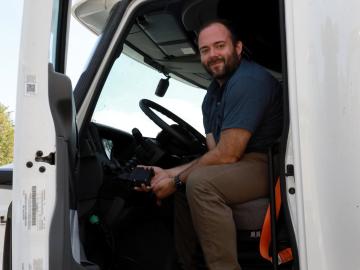
As vehicles gain technological capabilities, car manufacturers are using an increasing number of computers and sensors to improve situational awareness and enhance the driving experience.
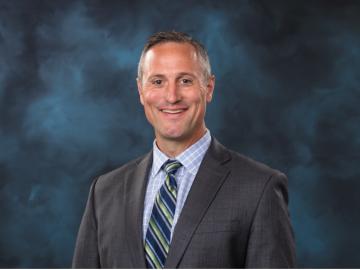
Mike Benson has spent the last 10 years using magnetic resonance imaging systems — much as you find in a hospital — to understand the fluid dynamics of flows around objects and even scaled replicas of cities. He aims to apply MRI scanning to

The Department of Energy’s Oak Ridge National Laboratory announced the establishment of the Center for AI Security Research, or CAISER, to address threats already present as governments and industries around the world adopt artificial intelligence and take advantage of the benefits it promises in data processing, operational efficiencies and decision-making.
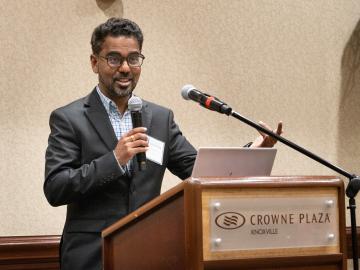
The Department of Energy’s Oak Ridge National Laboratory hosted its Smoky Mountains Computational Science and Engineering Conference for the first time in person since the COVID pandemic broke in 2020. The conference, which celebrated its 20th consecutive year, took place at the Crowne Plaza Hotel in downtown Knoxville, Tenn., in late August.