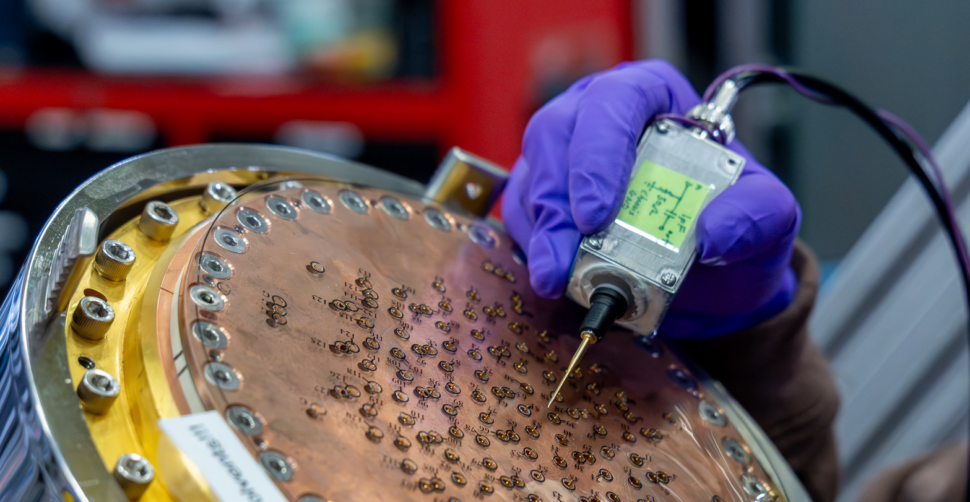
Building Instruments to Make the Invisible Visible
At Oak Ridge National Laboratory, detector science begins with questions that standard tools cannot answer. Across neutrino physics, nuclear structure and astrophysics, collider science, and radiological monitoring, ORNL researchers design and build advanced detectors that reveal rare signals, increase precision, and open new paths to discovery.
Detector science at ORNL is not a single technology or a single experiment. It is a physics-driven capability built around instrumentation, integration, electronics, computing, data systems, and analysis—developed to solve some of the hardest measurement problems in modern science.
Why Detector Science Matters
Detector science is what turns possibility into measurement. It takes phenomena that are too rare, too faint, or too complex to observe with standard tools and makes them accessible.
When researchers need to detect an event that may happen only rarely, separate subtle signals from overwhelming background, or capture information in extreme or uncertain environments, the detector becomes more than an instrument – it becomes part of the scientific breakthrough.
This is where ORNL excels. The laboratory combines deep experience in detector design with strengths in physics, materials, computation, user facilities, and large-scale collaboration. From germanium detectors used in rare-event searches to calorimeters and tracking systems for next-generation collider experiments, ORNL builds the tools needed to make the invisible visible.
The same capabilities that power these frontier physics experiments also strengthens national security. ORNL’s detector science not only advances our understanding of matter and the universe, but it also enhances sensing technologies that monitor nuclear materials, strengthen transparency, and improve the nation’s ability to identify and respond to emerging threats.
Learn More About ORNL and Detector Science
Looking Ahead
Detector science will continue to shape ORNL’s contributions to major physics experiments and quickly address the emerging real-world problems over the coming decades.
Future work includes scaling up detector systems for rare-event searches, building the first detector for the Electron-Ion Collider, expanding neutrino measurement capabilities, and advancing instrumentation for rare-isotope science. At the same time, ORNL is developing new readout architectures, detector materials, and analysis approaches that will influence the next generation of experiments. These efforts increasingly leverage AI/ML to accelerate data interpretation, enhance signal discrimination, and enable more autonomous, real‑time detector performance, ensuring ORNL continues to stay ahead of emerging challenges and future experimental and national security needs.
The goal is consistent across all these efforts: to build instruments that expand what science can observe, measure, and understand.