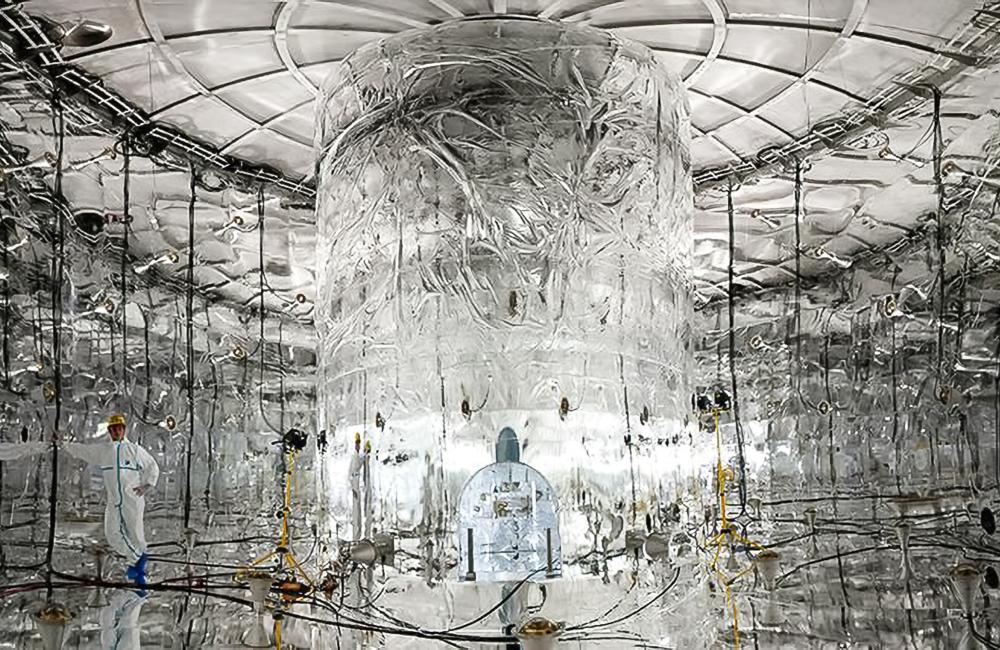
This project is about more than just one experiment.
- It’s about pushing the frontiers of knowledge to realize unforeseeable technologies that could improve all our lives.
- It’s about answering one of the most profound questions in science and strengthening U.S. leadership in discovery.
- It’s about understanding one of the smallest particles imaginable—the neutrino—then using that knowledge to illuminate the nature of the largest system imaginable—our universe.

The Question: Why is There More Matter Than Antimatter?
Modern physics explains much about how the universe works. But it does not yet explain why a small amount of matter survived in the early universe. Our current understanding indicates that equal amounts of matter and antimatter should have formed at the dawn of the universe and subsequently annihilated each other—yet matter, and thus life, persists. That unresolved contradiction is central to understanding why stars, planets, and people exist today.

The Opportunity: A Rare Chance to Uncover New Physics
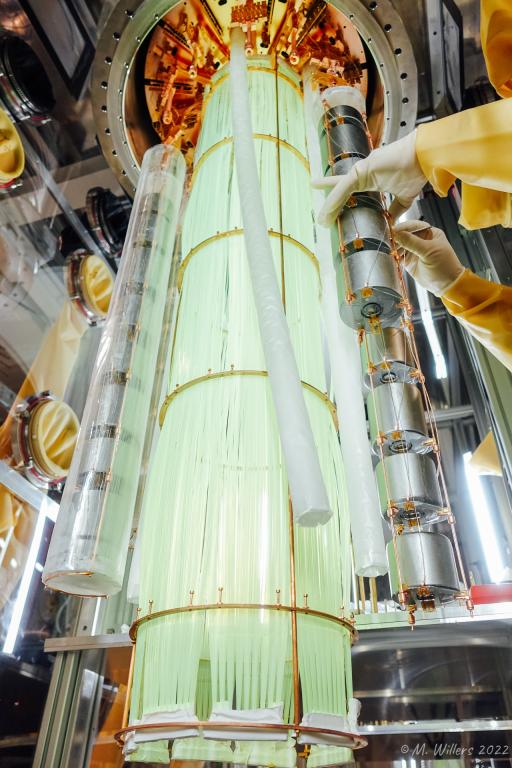
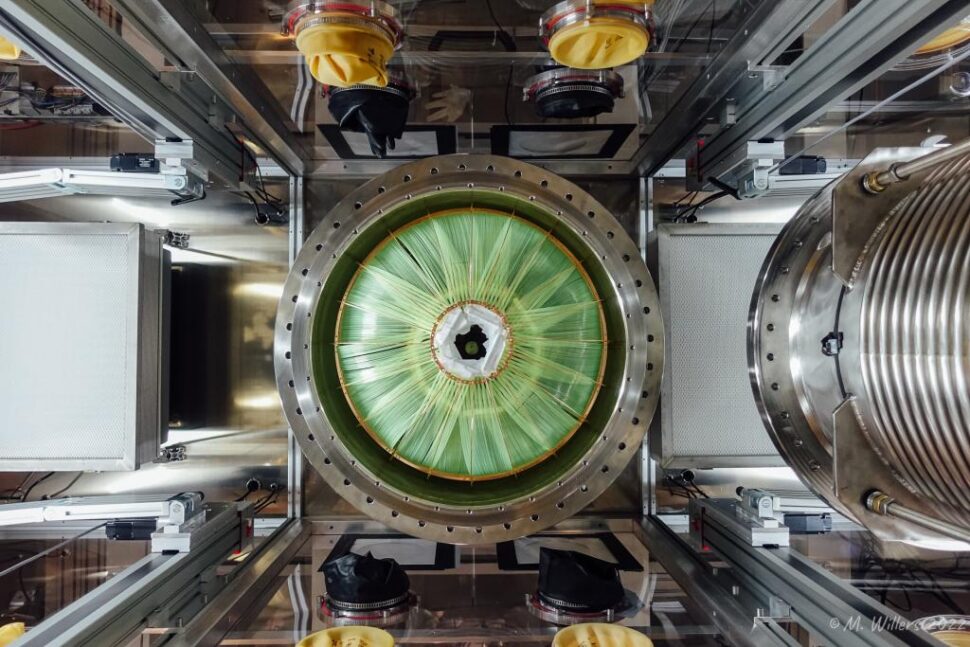
LEGEND-1000 is designed to look for evidence of neutrinoless double beta decay, a nuclear breakdown process that has long been hypothesized but never observed. Detecting it would reveal that important rules in today’s Standard Model are incomplete. It would mark a major scientific breakthrough with implications across particle physics, cosmology, and nuclear science.

The Impact: Discovery Science That Improves Our Future
History shows that foundational research yields disruptive new technologies and capabilities that were impossible to predict at the outset. Advances in physics have led to revolutionary technologies such as semiconductors, MRIs, PET imaging, lasers, and quantum technologies. The drive to understand nature at a deeper level is scientific, practical, and deeply human.
A More Complete Picture of the Universe
Defining the rules that govern the physical universe helps develop novel communication technologies (e.g., the internet, 5G wireless technology, and streaming video), advance energy abundance and drive toward a safer and more secure future. But we know there are important rules not yet defined in today’s models for fundamental physics. Thus, our understanding of the world in which we live—and therefore our ability to predict and manipulate it—is incomplete. Are there new types of fundamental particles yet undiscovered? New forces? If successful, LEGEND-1000 and new knowledge of the nature of the tiny neutrino will profoundly change our understanding of how particle physics works, which could lead to far-reaching applications such as new materials, technologies, and quantum science tools—and possibly even the study of elusive “dark matter.”
The Neutrino is an Important Mystery to Solve
The neutrino is the second most abundant particle in the universe, behind only light (i.e., photons). Five Nobel Prizes since the 1930s reflect discoveries about neutrinos and their behavior, yet scientists still know remarkably little about these “ghost particles.” About 100 trillion neutrinos pass through a person’s body every second—but because they rarely interact with matter, they are very hard to detect and study. Yet studying them is of critical importance, because the particles behave in ways that fall outside the standard rules of particle physics.
Thus, LEGEND-1000 and the nature of the tiny neutrino have the potential to profoundly change our rules for how fundamental physics works, leading to a disruptive new understanding of the universe. Opportunities and applications will be far-reaching and cannot be fully predicted, beginning with ground-breaking discovery science and new ultrasensitive methods to detect radioactivity for national security and public safety applications.
The Existence of Neutrinoless Double Beta Decay Would Show:
That the Neutrino is a Fundamental Majorana Particle
A Majorana particle is its own antiparticle. Many theorists believe that Majorana neutrinos could be the underlying cause behind the puzzle of matter-antimatter imbalance.
That Lepton Number is not Always Conserved
Leptons are a fundamental building block of matter and include both electrons and neutrinos, as well as other subatomic particles. According to the Standard Model, reactions within a nucleus maintain the same overall number of leptons before and after a reaction. Neutrinoless double beta decay would be clear validation that lepton number is not always conserved, because two neutrinos would be lost in the process, forcing revision of the Standard Model.
That There is a Path for Understanding the Matter-Antimatter Asymmetry in the Cosmos
Antimatter exists in the universe—and when antimatter and matter interact, they destroy each other, emitting light. In our description of the origin of the universe, equal amounts of matter and antimatter were created, which would have annihilated each other instantly leaving only formless energy. Because we exist and are made of matter, there are forces that prefer matter over antimatter. Such a mechanism has been discovered but is too weak to explain the observed matter–antimatter asymmetry. There has to be another, deeply fundamental force that contributes to this imbalance, and neutrinos might hold the key to answer this question.
That There is a New Mechanism Demonstrated for the Generation of Mass
All other fermions (except neutrinos) gain their mass through interactions with the Higgs boson. Neutrinos seem to possibly get their mass from some higher-energy physics, and the observation of neutrinoless double beta decay would indicate a mechanism beyond Higgs—which opens the door to frankly unimaginable new discoveries and advancements.

Capitalizing on meticulously designed and demonstrated technologies and an already-developed workforce puts America’s global leadership in the field of low-energy neutrino physics—and its powerful unknown capabilities—within reach as the largest double beta decay experiment of our time begins.