What is LEGEND-1000?
A massive next-generation underground experiment designed to detect an ultra-rare nuclear decay process in the element germanium.
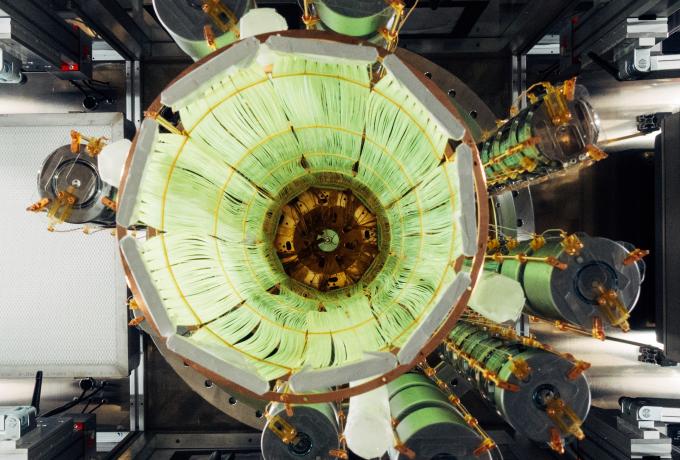
LEGEND-1000 stands for the Large Enriched Germanium Experiment for Neutrinoless Double Beta Decay. It will use about one ton of enriched germanium detectors to search for a distinctive signal that could show neutrinos behave in a way predicted but never observed before—that they are both matter and antimatter. In doing so, it will cast light on the nature of matter and create knowledge that will change our understanding of the universe and everything in it.

Why build it underground?
The signal that LEGEND-1000 is seeking is so faint that it could easily be hidden by background radiation. That is why the experiment must operate 5,000ft underground and use shielding, ultra-pure materials, and highly sensitive detectors to isolate true signals from noise.

Exquisite Design Using Germanium Detectors
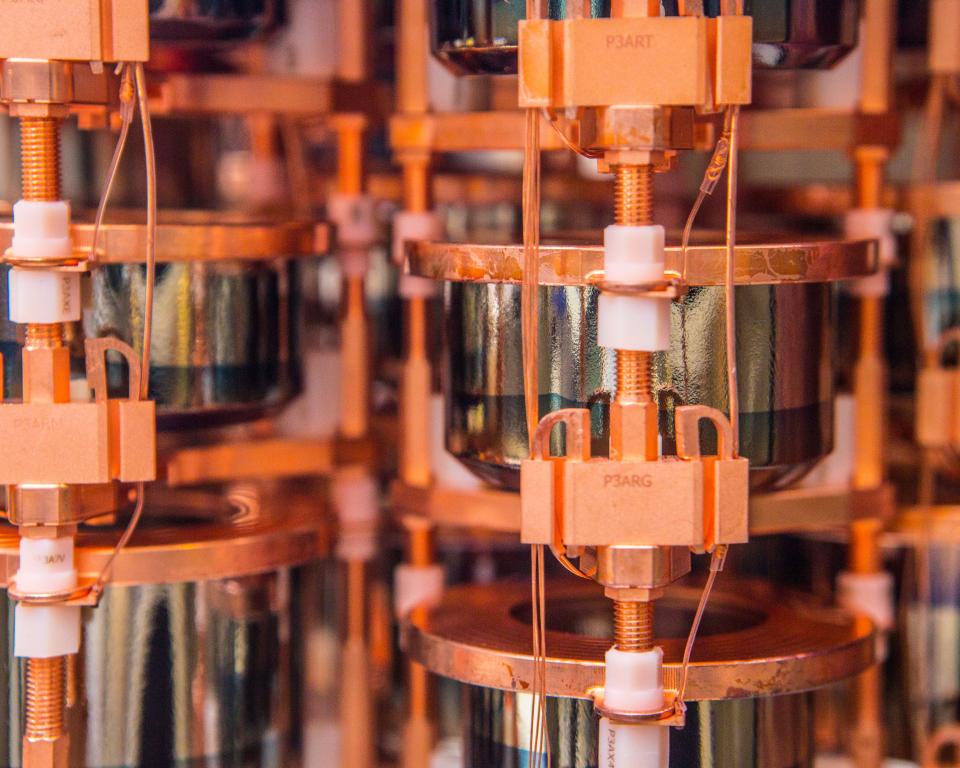
LEGEND takes advantage of the exceptional energy resolution of high-purity germanium detectors and the highly promising candidate isotope, germanium-76, for observing neutrinoless double beta decay.

Built Upon Decades of Progress
LEGEND-1000 builds upon prior neutrino detector experiments including the Majorana Demonstrator, the Germanium Detector Array (GERDA), and the LEGEND-200 experiment. Those efforts helped prove the technologies, methods, and strategy needed to make a ton-scale experiment powerful and sensitive enough to detect this elusive signal.

Atoms are the building blocks of all matter and the source of nuclear energy.
All atoms (heavier than hydrogen) have a nucleus containing positively charged protons and neutral neutrons, surrounded by negative electrons. Even lighter than these electrons are additional particles, including the “neutrino,” which literally means “little neutral one.” These are the ghostly particles at the heart of LEGEND’s mission.
Furthermore, according to the laws of nature as we presently understand them, every particle has a corresponding antiparticle in our current universe. For the neutrino, this is the antineutrino.
Nuclear Decay Will Provide the Signal
In a naturally occurring type of radioactive process called beta decay, an unstable nucleus ejects an electron and an antineutrino. Very rarely, in some special types of nuclei, including germanium isotopes, two beta decays can happen at the same time within a single nucleus, releasing two electrons and two antineutrinos. This process is called double beta decay.
Since the 1930s, scientists have questioned whether neutrinos are their own antiparticle, and LEGEND is searching for evidence of this by trying to observe a hypothetical version of this process called neutrinoless double beta decay, in which the antineutrino from one decay would interact with the antineutrino from the second decay, and their annihilation would prove that the neutrino is its own antiparticle.

If the two neutrinos cancel each other out, all the energy of the decay reaction would go to the electrons. This energy signature is what scientists hope to detect in LEGEND-1000.
If this annihilation indeed occurs, the LEGEND-1000 experiment can prove it has happened. The larger mass and lower backgrounds of LEGEND-1000 extend its reach for this and other Beyond Standard Model (BSM) searches well past that of the previous Majorana Demonstrator and GERDA experiments.
Detecting the Signal Will be an Immense Challenge
LEGEND’s sought-after rare decay is truly a needle in a haystack. We must get rid of the haystack; eliminate any spurious signal from space or radioactive materials that could mask the decay we are looking for. To create these conditions, we must:
- Use only the most ultra-pure materials.
- Build the experiment deep underground (at the Gran Sasso National Laboratory in Italy) to block cosmic rays.
- Operate the experiment in liquid argon active shielding.
- Use the most sensitive and precise detectors available (1028 atoms of Ge-76 made into HPGe detectors).
If observed, the existence of neutrinoless double beta decay would dramatically revise our foundational understanding of physics.