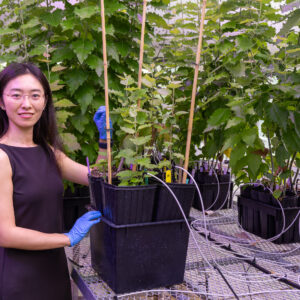
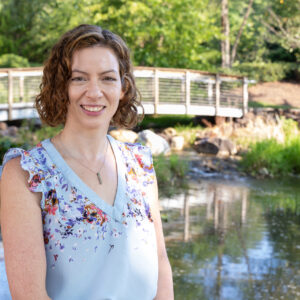
Mengjun Shu, a scientist at Oak Ridge National Laboratory, uses big data, statistical modeling and artificial intelligence to study how trees respond to environmental stress and identify traits that can improve biomass crops such as poplar. Her research combines genetics, plant imaging and microbial studies to advance biotechnology for U.S. manufacturing and agriculture while helping scientists better understand tree resilience.
The Department of Energy’s Oak Ridge National Laboratory scientists will lead nine and contribute to an additional 30 projects of the Genesis Mission, which aims to transform science in the U.S.
The Department of Energy’s Center for Bioenergy Innovation at Oak Ridge National Laboratory has named Adam Guss, John Lovell and Dan Olson as team leads for its Rapid Genetics, Poplar and Consolidated Bioprocessing research teams. The three scientists will help guide research spanning genetic engineering, poplar feedstocks and microbial bioprocessing to support CBI’s biotechnology mission.
Caleigh Samuels of ORNL has received the 2026 Elda E. Anderson Award from the Health Physics Society for her research excellence and contributions to radiation protection. She leads radiation dosimetry efforts at ORNL's Center for Radiation Protection Knowledge and supports national and international radiation safety initiatives.
ARM is modernizing its data center with AI-ready computing, storage, and software infrastructure to make its 30+ years of atmospheric data easier and faster for researchers to access and analyze. Key initiatives include the new AI-powered ARM Data Advisor (ADA) for conversational data discovery and the ATLAS framework, which enables secure, agent-based AI tools that automate workflows while maintaining scientific integrity and transparency.
Melissa Cregger discusses how ORNL’s Center for Bioenergy Innovation is developing fast-growing, resilient bioenergy crops such as poplar, switchgrass, pine, and eucalyptus to support sustainable production of fuels, chemicals, and materials. She highlights breakthroughs like the high-yield “Booster” gene and explains how AI, automation, and advanced phenotyping are accelerating the discovery and development of improved feedstocks for real-world growing conditions.
ORNL researchers developed tSAGE, a tool that rapidly engineers heat-loving microbes for industrial biotechnology. The platform can build and test hundreds of microbial strains in weeks instead of months or years. Researchers say it could improve manufacturing of fuels, chemicals and recycled products.
ORNL has named Katherine Kate Evans as associate laboratory director for the Biological and Environmental Systems Science Directorate. Evans will lead the directorate as it advances the science and technology needed to strengthen energy security, safeguard infrastructure and accelerate biotechnology innovation.
Orlando J. Rojas has been named the University of Tennessee-Oak Ridge National Laboratory Governor’s Chair for Circular Biomaterials. An internationally recognized leader in sustainable materials science, Rojas will hold a joint appointment in UT’s Herbert College of Agriculture and ORNL beginning in late 2026.
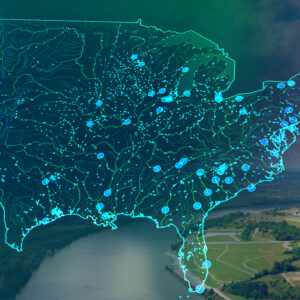
An ORNL AI model can accurately predict river temperatures across the U.S., even in waterways without sensors. The system achieves about a 1.1°C median error and can estimate temperatures for all river reaches nationwide. Researchers say it could improve power plant cooling, energy reliability and environmental management.
Scott DeNeale is a water resources engineer whose work at ORNL’s Water Power Program centers on how hydropower research can be applied to water-energy systems. His specialty is bridging the gap between the intellectual products, like data and theory, and real-world infrastructure solutions. Recently, he has been studying in-conduit hydropower, a type of largely unutilized energy production that harnesses the water flowing through water pipes in municipal settings and industrial plants to make energy, no dam required.
Lianhong Gu, distinguished staff scientist in the Biological and Environmental Systems Science Directorate at the Department of Energy’s Oak Ridge National Laboratory, has been named a fellow of the Ecological Society of America (ESA).