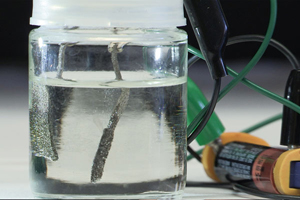
Graphene, a strong, lightweight carbon honeycombed structure that’s only one atom thick, holds great promise for energy research and development. Recently scientists with the Fluid Interface Reactions, Structures, and Transport (FIRST) Energy Frontier Research Center (EFRC), led by the US Department of Energy’s Oak Ridge National Laboratory, revealed graphene can serve as a proton-selective permeable membrane, providing a new basis for streamlined and more efficient energy technologies such as improved fuel cells.
Andrew Stack, a geochemist at the Department of Energy’s Oak Ridge National Laboratory, advances understanding of the dynamics of minerals underground.
Throw a rock through a window made of silica glass, and the brittle, insulating oxide pane shatters. But whack a golf ball with a club made of metallic glass—a resilient conductor that looks like metal—and the glass not only stays intact but also may drive the ball farther than conventional clubs. In light of this contrast, the nature of glass seems anything but clear.
If such a designation existed, Nazanin Bassiri-Gharb would be on the fast track to becoming an Oak Ridge National Laboratory “super user.” Her research on nanoscale materials has taken her all across the ORNL campus, from scanning probe and electron microscopes at the Center for Nanophase Materials Sciences to neutron reflectometry at the Spallation Neutron Source and radiation equipment in the Materials Science and Technology Division.
In 2015, American consumers will finally be able to purchase fuel cell cars from Toyota and other manufacturers. Although touted as zero-emissions vehicles, most of the cars will run on hydrogen made from natural gas, a fossil fuel that contributes to global warming.
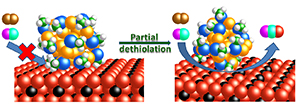
Old thinking was that gold, while good for jewelry, was not of much use for chemists because it is relatively nonreactive. That changed a decade ago when scientists hit a rich vein of discoveries revealing that this noble metal, when structured into nanometer-sized particles, can speed up chemical reactions important in mitigating environmental pollutants and producing hard-to-make specialty chemicals.
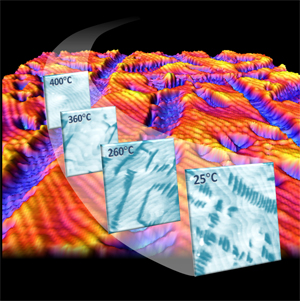
Highly strained films of multiferroic BiFeO3 are shown to exhibit a complex and temperature dependent coexistence of multiple phases, with a minority phase being a prerequisite to ferroelectric switching of the majority. Due to the simultaneous magnetic and ferroelectric room temperature propertie...
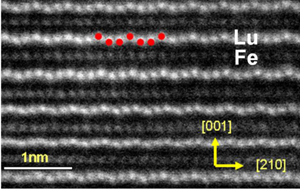
Atomically resolved scanning transmission electron microscopy (STEM) image of LuFeO3, a new room-temperature multiferroic. Red dots indicate the “buckling” of the Lu oxide plane, consistent with the polar structure. Hexagonal LuFeO3 is discovered to be the second example of a room temperature ...
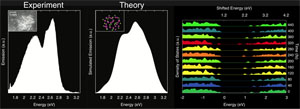
Combined scanning transmission electron microscopy (STEM) observations and density functional theory (DFT) calculations show why nanoparticles, which typically emit monochromatic light at an energy tuned by their size, suddenly are able to individually emit white light. White-light emission from n...