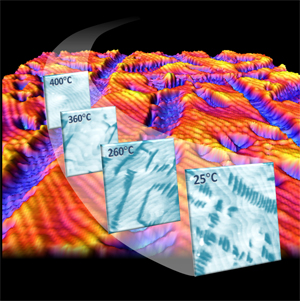
Highly strained films of multiferroic BiFeO
are shown to exhibit a complex and temperature dependent coexistence of multiple phases, with a minority phase being a prerequisite to ferroelectric switching of the majority. Due to the simultaneous magnetic and ferroelectric room temperature properties, BiFeO
films have been investigated by a large number of groups, but an understanding of the structure of different strain-induced polymorphs and their role in the functional behavior has been lacking.
Using a combination of temperature dependent measurements including x-ray diffraction, Raman spectroscopy, atomic-force microscopy and piezoelectric switching, it is now shown that the often observed stripe-like pattern in BiFeO3 films on LaAlO3 substrates emerges as a consequence of additional, thermally induced strain, and piezoelectric switching is only possible at the lower temperatures where these features exist. Therefore, even though the high-temperature purely tetragonal phase discovered here remains polar, its polarization cannot be reversed by an applied field. These findings may enable novel applications that rely on a polar state that can be “set” at room temperature but remains “locked” upon heating.
C. Beekman, W. Siemons, T. Z. Ward, M. Chi, J. Howe, M. D. Biegalksi, N. Balke, P. Maksymovych, A. K. Farrar, J. B. Romero, P. Gao, X. Q. Pan, D. A. Tenne, and H. M. Christen, “Phase transitions, phase coexistence, and piezoelectric swtiching behavior in highly strained BiFeO3 films.” Advanced Materials (2013), DOI: 10.1002/adma.201302066
For more information