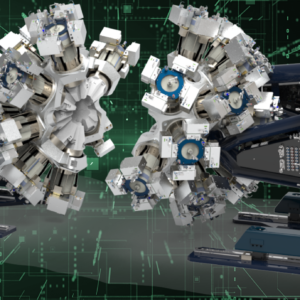
Researchers at ORNL used a quantum computer to simulate complex hadron collisions beyond classical capabilities. The work shows quantum computing’s potential to model particle interactions despite current limitations.
Researchers used the world’s fastest supercomputer for open science to train an artificial intelligence model that captures magnetic turbulence within a plasma in unprecedented detail. Results from the model could support research ranging from modeling a supernova to building the next generation of nuclear fusion reactors.
Researchers with the DOE's Quantum Science Center, led by ORNL, demonstrated the first digital quantum simulations of spin transport in one-dimensional materials, showing how quantum computers can model energy and information flow and advancing tools for studying complex quantum systems.
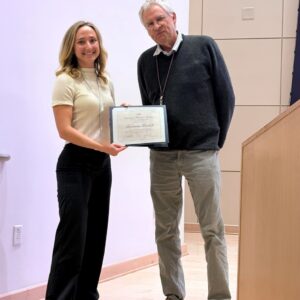
Leah Broussard, a research scientist in the Physics Division at ORNL, has received the inaugural DOE Distinguished Mentor Award for Workforce Development, recognizing scientists who guide and support the next generation of researchers.
Experiments conducted between 2002 and 2012 at ORNL studied 31 tin isotopes with varying numbers of neutrons to examine how neutrons affect nuclear stability and nuclear properties. The combined results contributed to identifying tin-132 as a doubly magic nucleus and improved theoretical models of nuclear structure.
ORNL Research and Development Associate Brennan Hackett received the Distinguished Service Award for organizing networking events aimed at welcoming young scientists to the prestigious professional organization.
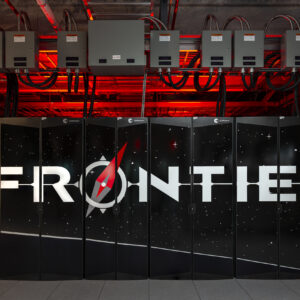
Five breakthrough simulation projects conducted on the Frontier supercomputer at ORNL have been named finalists for the Association for Computing Machinery’s Gordon Bell Prize. Four of the projects are in the running for the main prize and one project is contending for a special prize.
The innovative Celeritas project, led by ORNL, provides a software tool that makes sure simulations used to analyze particles can run on the fastest supercomputers, accelerating answers about the nature of the universe.
Researchers Sang-Ho Kim, An-Ping Li, Bronson Messer and Zac Ward of ORNL have been named Fellows of the American Physical Society in recognition of their outstanding impact in their respective fields.
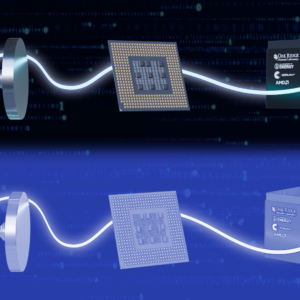
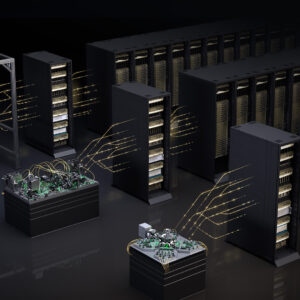
ORNL, NVIDIA, and HPE are partnering to integrate quantum computing, AI, and high-performance computing using NVIDIA NVQLink and CUDA-Q, establishing a hybrid testbed at ORNL to advance quantum–classical convergence and scientific discovery.
Analyzing massive datasets from nuclear physics experiments can take hours or days to process, but researchers are working to radically reduce that time to mere seconds using special software being developed at the Department of Energy’s Lawrence Berkeley and Oak Ridge national laboratories.
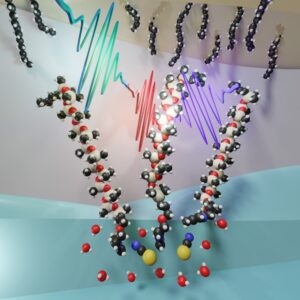
The structure of amphiphilic molecules at buried liquid/liquid interfaces can be controlled by ion-pairing interactions to better understand the mechanisms of liquid extraction and self-assembly.