David Page, head of the Geographic Data Science Section at Oak Ridge National Laboratory, leads with a focus on judgment, collaboration and empowering teams. Drawing on experience in academia, entrepreneurship and national security science, he has helped advance faster, scalable geospatial analysis while building resilient, forward-looking research teams.
Scientists at Oak Ridge National Laboratory are developing AI-enabled pixel detectors that can analyze particle-collision data directly at the source. The approach could help particle-physics experiments identify and capture the most important signals from the enormous amounts of data modern accelerators produce, helping scientists make faster, more informed discoveries from some of the world’s most complex experiments.
Researchers at ORNL will share their discoveries and innovations at DOE’s Advanced Research Projects Agency-Energy Energy Innovation Summit in San Diego, California.
ORNL is announcing the creation of the Institute for Next-Generation Data Centers, a new national institute dedicated to advancing the design, operation and integration of artificial intelligence data centers into the United States’ energy system.
ORNL has launched a novel robotic platform to rapidly analyze plant root systems as they grow, yielding AI-ready data to accelerate the development of stress-tolerant crops for new fuels, chemicals and materials. The new platform adds belowground imaging to ORNL’s Advanced Plant Phenotyping Laboratory.
A research agreement between ORNL and Louisiana State University will accelerate energy generation and critical materials manufacturing and enhance job growth in the fuel and chemical industries, particularly in the Gulf Coast region.
Researchers at ORNL have developed a deep learning algorithm that analyzes drone, camera and sensor data to reveal unusual vehicle patterns that may indicate illicit activity, including the movement of nuclear materials.
Scientists at ORNL have created a new method that more than doubles computer processing speeds while using 75 percent less memory to analyze plant imaging data. The advance removes a major computational bottleneck and accelerates AI-guided discoveries for the development of high-performing crops.
After more than 25 years of experience in condensed matter physics, as a student, researcher and in high-ranking executive roles at neutron scattering sources around the globe, Jon Taylor brings a wealth of experience and accomplishments to his new
Building on ORNL’s legacy in health physics, Caleigh Samuels uses AI to modernize radiation dosimetry models. Her work provides federal agencies with the accurate data needed to strengthen nuclear safety.
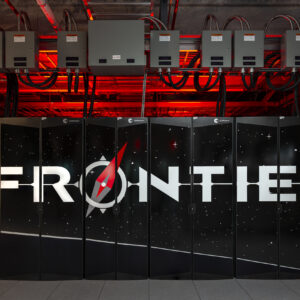
Five breakthrough simulation projects conducted on the Frontier supercomputer at ORNL have been named finalists for the Association for Computing Machinery’s Gordon Bell Prize. Four of the projects are in the running for the main prize and one project is contending for a special prize.
ORNL, NVIDIA, and HPE are partnering to integrate quantum computing, AI, and high-performance computing using NVIDIA NVQLink and CUDA-Q, establishing a hybrid testbed at ORNL to advance quantum–classical convergence and scientific discovery.