Click here for static version. What if one answer to the supply crisis isn’t buried in a mine shaft, but growing quietly in a field? For too long, the United States has relied on foreign sources for most of the raw materials powering its technological future, the essential minerals in every smartphone, battery pack and
ORNL earned a new lab record with 22 R&D 100 Awards in 2026 for technologies that advance energy, manufacturing, computing, biotechnology and other fields. ORNL led 18 of the winning technologies and contributed to four additional award-winning projects led by partner institutions.
John Lajoie, a physicist at ORNL, develops advanced particle detectors that help scientists study the fundamental structure of matter while often enabling innovations in other scientific fields. As spokesperson for the ePIC Collaboration, he is helping design the detector for the future Electron-Ion Collider, which will use cutting-edge detector technology, streaming data, and AI to explore how quarks and gluons shape protons, neutrons, and nuclear matter.
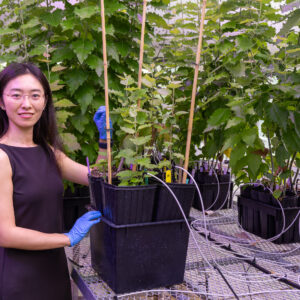
Mengjun Shu, a scientist at Oak Ridge National Laboratory, uses big data, statistical modeling and artificial intelligence to study how trees respond to environmental stress and identify traits that can improve biomass crops such as poplar. Her research combines genetics, plant imaging and microbial studies to advance biotechnology for U.S. manufacturing and agriculture while helping scientists better understand tree resilience.
Maria Mahbub, an ORNL research associate, develops trustworthy AI methods for healthcare, national security and drone detection, with a focus on improving AI reliability and robustness. Her work combines machine learning with domain expertise to help ensure AI systems perform accurately and reliably in real-world applications.
Caleigh Samuels of ORNL has received the 2026 Elda E. Anderson Award from the Health Physics Society for her research excellence and contributions to radiation protection. She leads radiation dosimetry efforts at ORNL's Center for Radiation Protection Knowledge and supports national and international radiation safety initiatives.
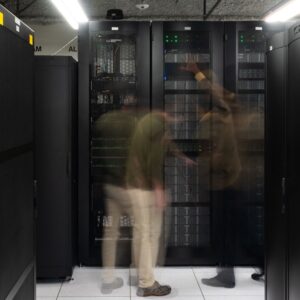
ARM is modernizing its data center with AI-ready computing, storage, and software infrastructure to make its 30+ years of atmospheric data easier and faster for researchers to access and analyze. Key initiatives include the new AI-powered ARM Data Advisor (ADA) for conversational data discovery and the ATLAS framework, which enables secure, agent-based AI tools that automate workflows while maintaining scientific integrity and transparency.
Behind every self-driving laboratory at ORNL is a team most people never see. Facilities and Operations workers are building and maintaining the infrastructure that makes autonomous science possible.
Tennessee Tech students partnered with ORNL to develop a tool that automatically extracts manufacturing equipment data from photos, reducing manual data entry. The project gives students real-world industry experience while helping ORNL improve its manufacturing software.
DOE's ROVI initiative, led in part by ORNL, successfully demonstrated the ROVI DataHub, a secure platform that unifies energy storage data across national labs and field projects to accelerate validation and deployment of long-duration energy storage technologies. The system supports real-time analytics, AI workflows and standardized reporting for next-generation battery technologies.
Robert Stewart turned a childhood fascination with maps and computers into a career at ORNL developing geospatial and AI tools for environmental cleanup and human security. His work has influenced nuclear remediation practices and supported efforts credited with saving lives. Today, he focuses on mentoring future scientists and advancing data-driven research at ORNL.
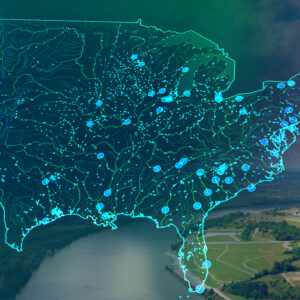
An ORNL AI model can accurately predict river temperatures across the U.S., even in waterways without sensors. The system achieves about a 1.1°C median error and can estimate temperatures for all river reaches nationwide. Researchers say it could improve power plant cooling, energy reliability and environmental management.