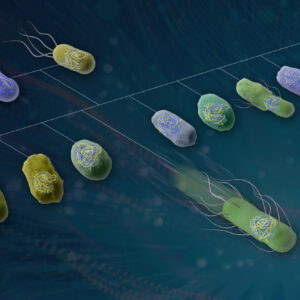
ORNL researchers are exploring how engineered bacterial spores could capture rare earth elements from acid mine drainage and other waste streams. The SpoREE project combines biology, AI and advanced analysis to develop reusable materials for recovering critical minerals.
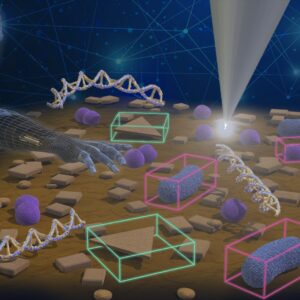
ORNL researchers developed SimuScan, an AI framework that uses realistic synthetic data to identify nanoscale features in atomic force microscope images. It can guide microscopes toward the most informative areas of a sample for closer study.
ORNL researchers developed two domestically sourced materials for Smith-Root’s environmental DNA samplers that are cheaper and meet or exceed performance requirements. The materials could improve filtration while reducing reliance on international suppliers.
Click here for static version. What if one answer to the supply crisis isn’t buried in a mine shaft, but growing quietly in a field? For too long, the United States has relied on foreign sources for most of the raw materials powering its technological future, the essential minerals in every smartphone, battery pack and
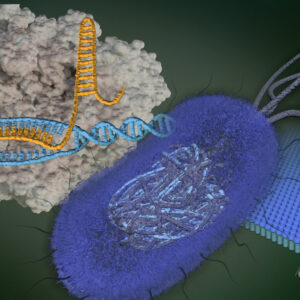
ORNL researchers evaluated nearly 500,000 CRISPR-Cas9 guide RNAs in E. coli and found that more than 93 percent work as intended. Their free gRNA Atlas helps scientists select reliable guides and engineer microbes more efficiently for producing chemicals, materials and medicines.
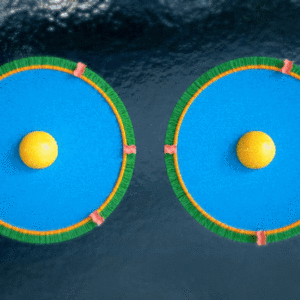
ORNL researchers found that lipid bilayers, the basic structure of cell membranes, can exhibit electrical behaviors associated with learning and memory. The discovery could advance brain-inspired computing technologies and provide new insights into neurological disorders.
Oak Ridge National Laboratory researchers developed a high-throughput microbial QTL mapping platform that combines synthetic biology, AI, automation and gene editing to identify the genetic basis of complex bacterial traits up to 10 times faster than previous methods. The platform enables more precise engineering of microbes for applications including specialty chemicals manufacturing, bioenergy and critical minerals recovery, and is available for licensing.
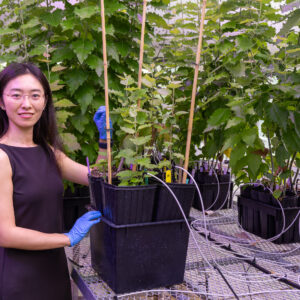
Mengjun Shu, a scientist at Oak Ridge National Laboratory, uses big data, statistical modeling and artificial intelligence to study how trees respond to environmental stress and identify traits that can improve biomass crops such as poplar. Her research combines genetics, plant imaging and microbial studies to advance biotechnology for U.S. manufacturing and agriculture while helping scientists better understand tree resilience.
The Department of Energy’s Center for Bioenergy Innovation at Oak Ridge National Laboratory has named Adam Guss, John Lovell and Dan Olson as team leads for its Rapid Genetics, Poplar and Consolidated Bioprocessing research teams. The three scientists will help guide research spanning genetic engineering, poplar feedstocks and microbial bioprocessing to support CBI’s biotechnology mission.
Caleigh Samuels of ORNL has received the 2026 Elda E. Anderson Award from the Health Physics Society for her research excellence and contributions to radiation protection. She leads radiation dosimetry efforts at ORNL's Center for Radiation Protection Knowledge and supports national and international radiation safety initiatives.
ARM is modernizing its data center with AI-ready computing, storage, and software infrastructure to make its 30+ years of atmospheric data easier and faster for researchers to access and analyze. Key initiatives include the new AI-powered ARM Data Advisor (ADA) for conversational data discovery and the ATLAS framework, which enables secure, agent-based AI tools that automate workflows while maintaining scientific integrity and transparency.
Melissa Cregger discusses how ORNL’s Center for Bioenergy Innovation is developing fast-growing, resilient bioenergy crops such as poplar, switchgrass, pine, and eucalyptus to support sustainable production of fuels, chemicals, and materials. She highlights breakthroughs like the high-yield “Booster” gene and explains how AI, automation, and advanced phenotyping are accelerating the discovery and development of improved feedstocks for real-world growing conditions.