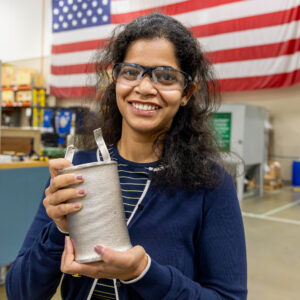
Researchers at the Department of Energy’s (DOE) Oak Ridge National Laboratory (ORNL) and their collaborators received a 2026 Award for Composites Excellence, or ACE Award, for developing a large-format, 3D-printed water-soluble polymer mandrel for manufacturing lightweight, linerless Type V composite pressure vessels. The vessels store hydrogen, compressed natural gas, nitrogen and helium for the aerospace,
Researchers at the Department of Energy’s (DOE) Oak Ridge National Laboratory (ORNL) used the world’s fastest supercomputer for open science to develop a quantum algorithm that could lead to more advanced models in fluid dynamics and other scientific fields. The results of the study, supported by the Oak Ridge Leadership Computing Facility’s (OLCF) Frontier supercomputer
Labor shortages, supply-chain volatility and growing demand for customized products are forcing a fundamental rethink of how work gets done in U.S. manufacturing. To remain competitive, manufacturers must produce increasingly complex parts with fewer workers, shorter lead times and greater flexibility than ever before. Inside the Department of Energy’s (DOE) Manufacturing Demonstration Facility (MDF) at
With support from the Department of Energy (DOE) national laboratories, including Oak Ridge National Laboratory (ORNL), Texas-based company Element3 has launched the first domestic lithium mining project in 50 years. This achievement is likely to have a big impact, turning the United States from a net importer of lithium to a country well on the
More than 200 experts from industry, government, academia and national laboratories gathered at the Department of Energy’s Manufacturing Demonstration Facility (MDF) at Oak Ridge National Laboratory in October 2024 to identify opportunities for and challenges to adoption of the technology. Their conclusions, available in a new report, point to a rapidly growing field with the potential to transform advanced manufacturing.
ORNL and Boeing 3D printed a nearly 2-ton metal mold to explore faster, more efficient manufacturing of thermoplastic composite aircraft parts. The project demonstrates how large-scale additive manufacturing could support aerospace and other U.S. industries.
Turning a new energy or manufacturing technology into a company can take years of research, specialized equipment and substantial investment. For nearly a decade, Innovation Crossroads, rooted at Oak Ridge National Laboratory, has given hard-tech entrepreneurs access to resources designed to help overcome those barriers.
ORNL researchers developed two domestically sourced materials for Smith-Root’s environmental DNA samplers that are cheaper and meet or exceed performance requirements. The materials could improve filtration while reducing reliance on international suppliers.
ORNL’s M2IND brought together more than 350 leaders from industry, government and research to address manufacturing challenges, including supply chains, workforce gaps and technology qualification. The forum also highlighted new partnerships and advanced manufacturing projects aimed at accelerating U.S. industrial deployment.
ORNL researchers more than doubled the peak power of a low-cost salt water battery by using a bleach-producing side reaction. Developed with Coulomb Technology, the battery avoids critical materials and could support long-duration grid energy storage.
ORNL earned a new lab record with 22 R&D 100 Awards in 2026 for technologies that advance energy, manufacturing, computing, biotechnology and other fields. ORNL led 18 of the winning technologies and contributed to four additional award-winning projects led by partner institutions.
ORNL researchers have developed a hybrid manufacturing method that combines 3D printing and electroforming to create leak-free HIP cans for advanced nuclear reactor components. The approach could simplify production of complex metal parts, reduce costs and reliance on overseas manufacturing, and strengthen U.S. supply chains for nuclear energy and defense applications.