
Key Points
- ORNL researchers are developing intelligent automation systems that help manufacturers operate efficiently with smaller workforces.
- Work at the Manufacturing Demonstration Facility integrates robotics, sensing and advanced controls to increase flexibility and reduce production time.
- These technologies are strengthening U.S. manufacturing competitiveness by supporting faster deployment and securing domestic supply chains.
Labor shortages, supply-chain volatility and growing demand for customized products are forcing a fundamental rethink of how work gets done in U.S. manufacturing. To remain competitive, manufacturers must produce increasingly complex parts with fewer workers, shorter lead times and greater flexibility than ever before.
Inside the Department of Energy’s (DOE) Manufacturing Demonstration Facility (MDF) at Oak Ridge National Laboratory (ORNL), researchers are addressing these challenges by designing, integrating and validating intelligent automation systems tailored for high-mix, low-volume production. Rather than competing on labor costs, these smart, flexible systems allow U.S. manufacturers to differentiate through capability, speed and adaptability. By sensing their environment and responding to variability in real time, these systems improve speed, consistency and reliability — capabilities that are becoming essential as workforce constraints persist and production grows more complex.
At the center of this work is Joshua Vaughan, leader of ORNL’s Manufacturing Robotics and Controls Group. Vaughan and his team focus on automation systems designed not for traditional mass production, but for the flexible, variable manufacturing that increasingly defines U.S. industrial demand. Their work emphasizes automation to extend the reach of a constrained workforce, closing productivity gaps that have historically disadvantaged U.S. manufacturers in global markets.
“Domestic manufacturing productivity has largely plateaued since 2012,” said Vaughan. “At a time when productivity is of critical national importance, robotics and automation are a powerful workforce multiplier.”
Rethinking the U.S. manufacturing model
For decades, low-cost overseas labor shaped global manufacturing decisions, often pushing production outside the United States. That approach was built for stability and scale — conditions that no longer define today’s manufacturing landscape. Supply chains are increasingly fragile, product designs are more customized and skilled labor is harder to find and retain.
Traditional automation systems designed to perform the same task repeatedly struggle under these conditions. Reprogramming equipment for each new product variation slows production and limits flexibility, making productivity gains harder to achieve, even as expectations for speed and customization continue to rise.
For Vaughan, addressing these challenges requires rethinking what automation is designed to do.
“Automation isn’t just about replacing labor,” Vaughan said. “It’s about multiplying the impact of the workforce you do have — giving people tools that make production faster and more resilient.”
Inside the Manufacturing Demonstration Facility
MDF plays a central role in advancing this new approach to automation. As a national user facility supported by DOE’s Advanced Materials and Manufacturing Technologies Office (AMMTO), MDF allows researchers and industry partners to test advanced manufacturing technologies at relevant scale, bridging the gap between laboratory innovation and factory deployment.
“At MDF, automation research is tightly integrated with additive manufacturing, materials science and advanced controls, enabling our team to examine how entire production workflows can be automated, monitored and optimized,” said Ryan Dehoff, MDF director.

Advanced manufacturing technologies enabling flexible U.S. production
ORNL-developed technologies demonstrate how intelligent automation can directly address today’s manufacturing constraints, allowing manufacturers to do more with fewer workers while strengthening domestic supply chains.
Additively reinforced thermoforming (ART) addresses a key challenge in polymer manufacturing: producing lightweight, high-strength components without costly tooling or extensive secondary operations. ART combines additive manufacturing with thermoforming, selectively reinforcing flat thermoplastic sheets with 3D-printed patterns before forming them into three-dimensional shapes.
By eliminating metal reinforcements and reducing secondary operations, ART lowers costs, simplifies production and, when paired with in-line sensing and process monitoring, can improve quality control, making it well suited for scalable, cost-sensitive manufacturing.
Wire-arc additive manufacturing (WAAM) tackles another long-standing challenge: the domestic production of large, complex metal components. Using robotic systems enhanced with real-time sensing, data analytics and adaptive control, WAAM improves precision while reducing defects and material waste.
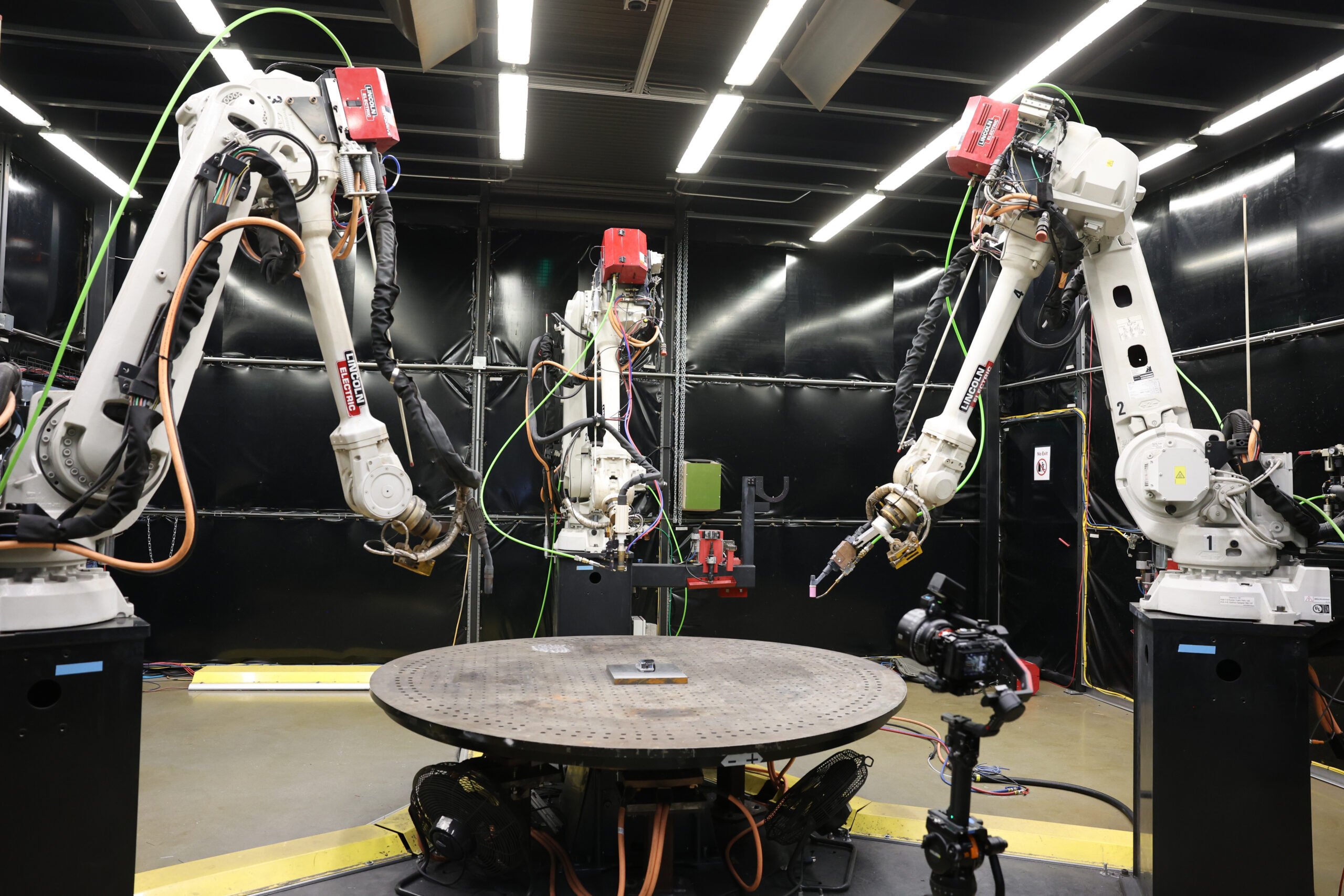
At MDF, researchers have advanced WAAM from a promising concept to a high-throughput production tool. Although the technology has proven effective for producing large parts in low volumes, components for energy and defense applications can be so massive that a single robotic arm would require excessive build times. To overcome this limitation, ORNL developed MedUSA, an R&D 100 Award-winning WAAM system that coordinates three independent robotic arms equipped with welders within a shared build envelope.
Using intelligent control systems, the arms operate collaboratively without colliding, performing simultaneous deposition, in-process sensing and adaptive control. By leveraging real-time data from the weld heads, the system eliminates the need to scan each deposited bead, streamlining production without sacrificing accuracy. The result is faster deposition rates, greater geometric complexity and more efficient production of large-scale metal structures.

Building on these advanced controls, the R&D 100 Award-winning Future Foundries platform further expands WAAM’s impact. The convergent manufacturing system integrates additive deposition, machining and inspection into a single automated workflow, reducing production time by up to 68 percent.
ORNL researcher Thomas Feldhausen said this level of integration fundamentally changes manufacturing timelines.
“By integrating additive, machining and other critical steps together into a single platform, we’re reducing lead times, cutting costs and expanding what’s possible for U.S. industry,” said Feldhausen. “The result is a flexible manufacturing system that helps companies compete globally and strengthens domestic supply chains.”
Additive manufacturing–compression molding (AMCM) is designed for speed and repeatability in composite manufacturing. By combining benefits of additive printing with compression molding, AMCM produces finished parts in minutes rather than hours, significantly reducing labor intensity while enabling rapid design iteration. The system uses aligned short fibers that reinforce the entire part, producing lightweight parts with much higher strength than typical 3D-printed composites made using traditional processes. This highly automated approach — recognized with an R&D 100 Award — is particularly valuable for automotive and aerospace interior applications.
Complementing this capability is ORNL’s CAMX ACE Award-winning multiplexing extrusion platform, which merges multiple smaller extruders into a single high-output stream through patent-pending nozzle blocks. The system enables multi-material printing within a single bead, including core-and-sheath structures, achieving material property combinations not previously possible. The platform expands the versatility and scalability of large-format additive manufacturing while maintaining precision and flow rate control.
Rapid RUNNERS — Rapid Research on Universal Near Net Shape Fabrication Strategies for Expedited Runner Systems — illustrates how these technologies can be applied at infrastructure scale. The DOE-supported initiative uses near-net-shape fabrication techniques — combining additive deposition with subtractive processing — to produce large hydropower turbine runners, aiming to dramatically reduce production timelines that currently exceed one year.
“Rapid RUNNERS is laying the groundwork for a new manufacturing model for domestic production of critical energy infrastructure components,” said ORNL researcher Adam Stevens. “While the full production-scale approach has not yet been fully demonstrated, ORNL is working with industry representatives to transition this model to practice, enabling reduced lead times of key components and expanding domestic manufacturing capabilities. What we’re demonstrating here can extend beyond hydropower to applications in the broader energy sector, national security and other large-scale industrial systems.”
Intelligent automation and robotics on the U.S. factory floor
Beyond individual technologies, ORNL’s robotics research focuses on intelligent automation systems that reduce downtime, minimize rework and speed production changeovers. These systems sense operating conditions, make decisions and adjust operation during production, capabilities that directly address labor constraints and production variability.
Key capabilities include collision-free robotic motion planning, machine vision, digital twins for monitoring and simulation, and data-driven adaptive control. Together, these tools reduce reliance on task-specific programming and allow fewer workers to supervise multiple processes simultaneously.
Rather than fully autonomous factories, Vaughan envisions production environments where people and robots work together — combining human judgment with machine precision and endurance.
Why manufacturing automation matters for U.S. competitiveness
Automation is no longer just a pathway to efficiency — it is a strategic response to fundamental shifts in manufacturing. As labor constraints persist and production demands become more complex, intelligent automation enables manufacturers to maintain productivity and flexibility while operating with leaner workforces.
This work aligns directly with DOE priorities to strengthen U.S. industrial competitiveness and enhance energy security by building a more resilient domestic manufacturing base for critical components. By accelerating the transition from research to deployment, ORNL is equipping manufacturers with practical automation tools for the factory floor.
The future of U.S. manufacturing and industrial automation
The factory of the future is not defined by fewer people, but by smarter systems that allow the workforce to do more. At MDF, those systems are already being designed, tested and demonstrated — translating research into practical automation solutions that can be deployed on factory floors today and helping reshape U.S. manufacturing for a more resilient and competitive future.
The Manufacturing Demonstration Facility is supported by AMMTO and acts as a nationwide consortium of collaborators focused on innovating, inspiring and catalyzing the transformation of U.S. manufacturing.
UT-Battelle manages ORNL for the DOE’s Office of Science, the single largest supporter of basic research in the physical sciences in the United States. The Office of Science is working to address some of the most pressing challenges of our time. For more information, please visit energy.gov/science. — Tina M. Johnson
Related Researchers