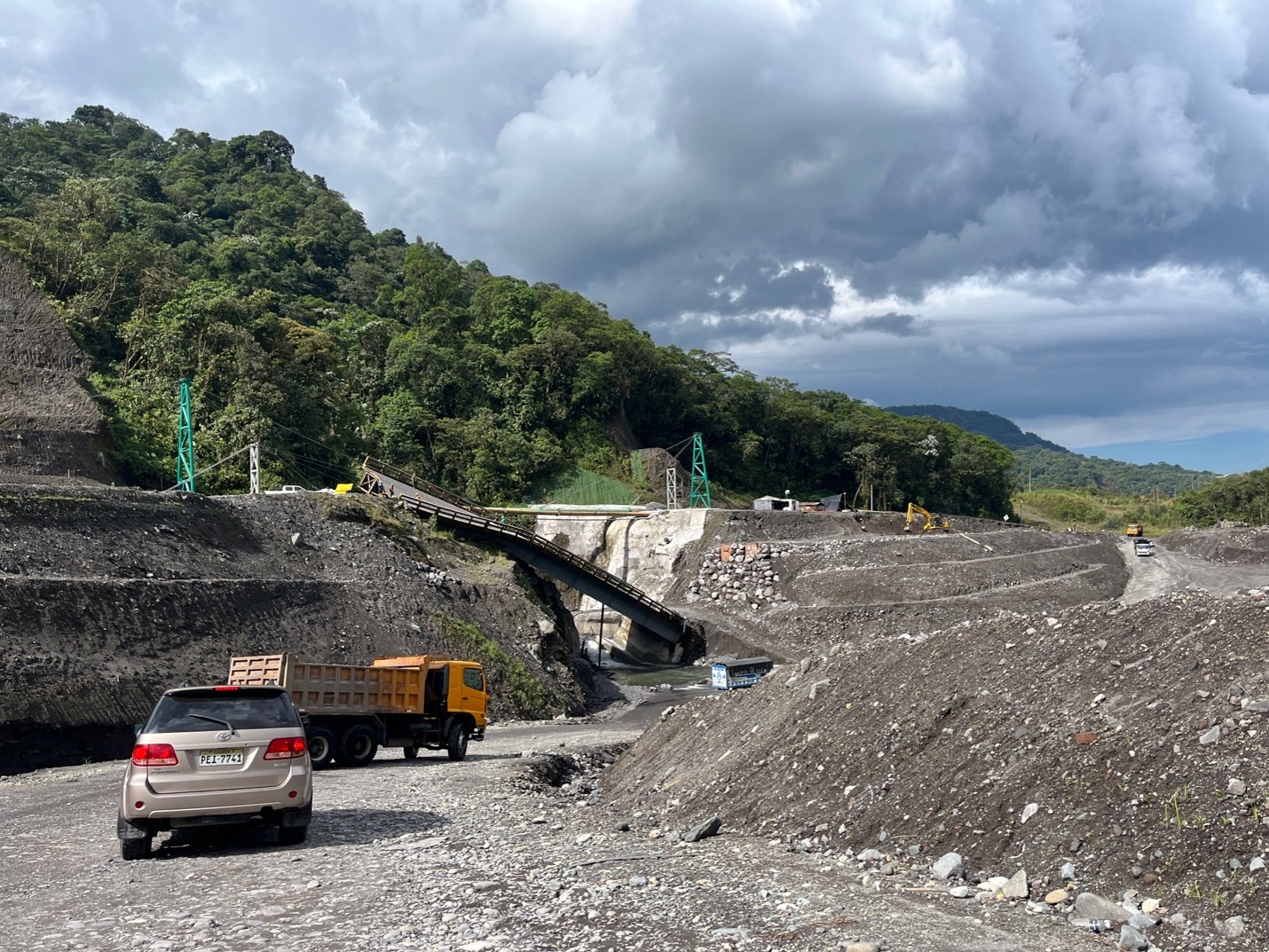
When emergency crews, military teams or disaster responders collect drone imagery in remote locations, quickly sharing, organizing and interpreting that data can be difficult, especially with spotty internet connections and unreliable area networks. To solve this problem, Virginia-based Tri-Bolt Technologies has licensed MAPSTER Nomad (Multi-Platform Automated Processing, Storage, Tasking, Exploitation and Retrieval), a geospatial data-sharing software platform developed by researchers at the Department of Energy’s (DOE) Oak Ridge National Laboratory (ORNL). Designed, tested and proven on land, sea and air deployments across six continents, MAPSTER takes input from uncrewed systems and sensor arrays to automate swift data collection, assortment, analysis, management and sharing.
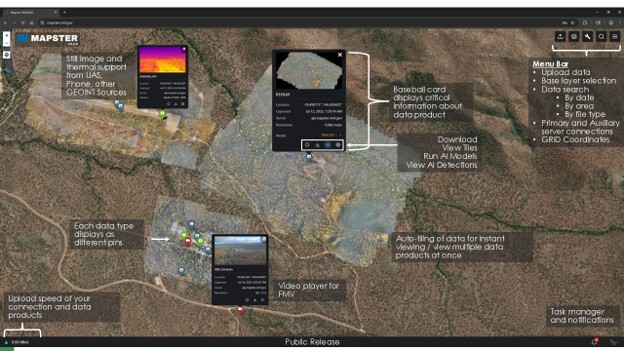
The challenge extends beyond connectivity. Today, teams in the field collect ever-increasing amounts of uncrewed system-based images and video — often on differing file systems, storage devices and platforms — and then must try to analyze that data. Via its creative architecture, MAPSTER translates this information onto a shared, searchable, near-real-time-updated map that’s accessible to all users. As a result, teams are empowered to make decisions quickly, without having to translate their data.

“MAPSTER’s ability to operate at the ‘edge’ is what makes it unique,” said Matt Larson, R&D staff scientist at ORNL’s Autonomous Systems Group. “Instead of relying on cloud infrastructure, it can run directly on local devices or field servers in remote environments where traditional, cloud-based tools struggle. It turns scattered, raw sensor data into a shared, live understanding of what’s happening on the ground, enabling responders, operators and analysts to make faster, more informed decisions.”
Licensed by a veteran to empower teams in the field
Founded by CEO Mike Shellenberger — a Virginia native and former Green Beret with 20 years of experience in Army Special Forces — MAPSTER licensee Tri-Bolt is 100%-U.S.-owned, a small, disabled-veteran-owned business offering integrated data management technology for business sectors that require fluid operational intelligence.
“What started as a technical solution to streamline imagery workflows grew into a company focused on delivering a scalable, secure platform that works with any uncrewed system and supports distributed teams,” said Shellenberger. “What I’m most proud of is that the platform stays focused on practical utility, helping teams move from raw data to shared understanding, quickly and efficiently, rather than just creating another visualization tool.”
In real-world applications, up-to-the-moment, accurate field intelligence can easily mean life or death for search-and-rescue or conflict operations. Tri-Bolt will use MAPSTER to bolster mission success for clients who rely on field intelligence, enabling a variety of users in disparate areas to share emerging data from scattered assets in near-real time.
“When a hurricane, wildfire or flood event occurs, response coordinators need near-real-time damage maps that field teams and remote analysts can access simultaneously,” said Doug Mann, embedded engineer at ORNL’s Autonomous Systems Group. “Our ‘fresh data, fresh models’ ecosystem benefits both researchers and end users and is especially valuable here. Field data from an active disaster can flow back to researchers refining detection models, while improved models are immediately available to operators on the ground, all within the same platform.”
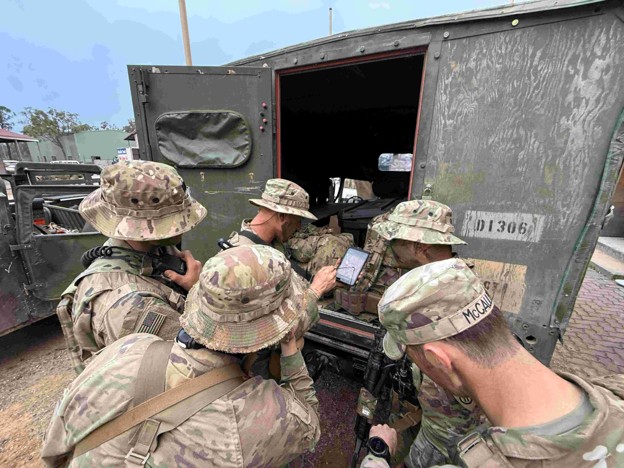
Supporting small businesses and the lab-to-marketplace pipeline
This exclusive agreement between ORNL and Tri-Bolt exemplifies ORNL’s efforts to boost small businesses with licensure of innovative technologies derived from its own laboratory research. Part of the lab’s mission is to help industry — not only by de-risking new or cutting-edge technology — but also by designing accessible, feasible agreements for small businesses.
“The licensing agreement with ORNL allowed me to commercialize a valuable technology that would have otherwise never grown into a fully integrated solution for our customers,” said Shellenberger. “My company’s unique background and the lab’s cutting-edge developers and tools enabled us to merge our skills into a truly powerful product.”
“Working on MAPSTER and seeing its potential for real-world impact — particularly in disaster relief situations — was super motivating. Seeing technology you’ve worked hard to create becoming a tangible product in the private sector for a small business is extremely gratifying for the entire team,” said Tyler Waddle, embedded software engineer in the lab’s Autonomous Systems Group. “MAPSTER is in good hands with Tri-Bolt.”
From access to transformative entrepreneurship programs, such as Innovation Crossroads, to actively engaged input from world-class researchers — as well as uniquely equipped facilities — ORNL’s Technology Transfer Office brings together the capabilities of the nation’s largest R&D lab for science and technology. These efforts can be transformative for emerging technology and small businesses, helping startups build from licensing agreements into products with real-world impact that can alter entire industries.
“What stood out about Tri-Bolt was how motivated Mike [Shellenberger, Tri-Bolt CEO] is, and how clearly he understands the value of the ORNL software,” said Justin Neu, Commercialization Group manager who negotiated the exclusive copyright licensing agreement with Tri-Bolt. “He not only appreciated the technical strengths of the software but also how it could translate into real value in a commercial setting.”
For Tri-Bolt, Shellenberger has his eye on steady expansion of MAPSTER’s reach, leaning further into real-world workflow integration.
“At this stage, it’s about scaling impact, refining the technology, deepening partnerships and continuing to enhance artificial intelligence [now referred to as Super Intelligence]-enabled geospatial capabilities in a way that remains practical and deployable,” he said. “The long-term vision is to support teams that rely on timely, shared situational awareness, whether in disaster response, infrastructure monitoring or other mission-driven environments.”
UT-Battelle manages ORNL for the Department of Energy’s Office of Science, the single largest supporter of basic research in the physical sciences in the United States. The Office of Science is working to address some of the most pressing challenges of our time. For more information, please visit energy.gov/science. — Chris Driver