Scientific Achievement: Weakly solvating electrolytes revealed that reduced Li⁺ solvent coordination promotes stable anion-derived interphases, improving Li deposition and electrochemical stability.Significance and Impact: This work advances understanding of ion-solvent-anion interactions that control interfacial stability and lithium deposition behavior, which is critical for the advancement of next generation high-energy-density energy storage systems and their safety.DOI: 10.1002/advs.75550
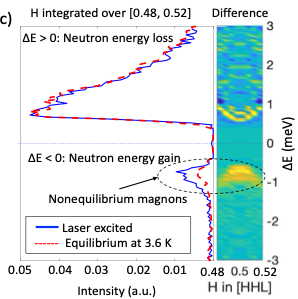
Scientific Achievement: Laser pumping combined with inelastic neutron scattering reveals long-living nonequilibrium magnons in a 2D Heisenberg antiferromagnet that break detailed balance in the structure factor and form steady states under periodic driving, analogous to driven dissipative nonequilibrium systems.Significance and Impact: This work opens a previously unexplored frontier: momentum- and energy-resolved studies of dissipative quantum dynamics at milli-electron-volt energy and microsecond time scales.DOI: 10.1038/s41467-026-71068-w
Scientific Achievement: Molecular beam epitaxy and first principles calculations demonstrate that substrate termination can be used to control the crystal phase and functional properties.Significance and Impact: Epitaxy provides a powerful “design knob” for stabilizing targeted quantum states through interfacial phase engineering, thereby enabling new technologies such as altermagnetic spintronics and multifunctional electronics.DOI: 10.1021/acsami.5c14582
New AI tools are transforming global weather data into fast, high-resolution water forecasts that support energy systems. This approach delivers near real-time insights to strengthen grid reliability, infrastructure resilience, and water management.
AI is connecting plant genetics to real-world traits to better understand and improve photosynthesis. This work helps accelerate the development of more productive energy crops and supports the future of biotechnology.
AI is speeding up complex Earth system modeling, turning days of computation into just hours. Faster predictions help improve decision-making for energy systems and reduce uncertainty in how natural systems behave.
Scientific Achievement: Accurate many-body calculations predict a disorder transition in MnBi₂Te₄ involving Bi(Mn) antisites well below its synthesis temperature.Significance and Impact: Work explains the experimental difficulties in obtaining defect-free MnBi₂Te₄, a layered magnetic topological insulator with potential for next-generation quantum devices.DOI: 10.1038/s41524-026-02019-8
Scientific Achievement: Discovered nanoscale exciton confinement in a monolayer 2D semiconductor induced by electron-beam patterning via an unconventional electrostatic gating effect.Significance and Impact: Provides a pathway for precise, rewritable manipulation of quantum photonic devices, exciton routers, and analog quantum simulators.DOI: 10.1002/adfm.202524575
Scientific Achievement: Mo isotope labeling and molecular dynamics (MD) calculations revealed how vdW interactions with the substrate control the synthesis pathway of bilayer MoS2 – driving underlayer growth on SiO2/Si but overlayer growth on sapphire.Significance and Impact: Work provides mechanistic insight into confined epitaxial growth and establishes isotope labeling as a powerful probe of 2D materials synthesis.DOI: 10.1021/acsnano.5c20844
Scientific Achievement: Identified mesoscale phase separation and a corresponding variation of magnetic anisotropy driving the formation of spin textures in high-ordering temperature ferromagnet Fe5-xGeTe2 (FGT).Significance and Impact: Established a direct, quantitative relationship between local magnetic anisotropy and Fe-vacancy distribution in FGT, enabling logical design of magnetic properties.DOI: 10.1002/adma.202515150
Scientific Achievement: Understanding how Bi2Se3 bonds to 1D atomic scale steps enables growth of single-domain topological insulator films without twin defects.Significance and Impact: This work demonstrates a simple, scalable method to improve the growth of topological insulators and other two-dimensional materials for quantum and electronic applications. DOI: 10.1002/adfm.202513054
Scientific Achievement: Ab initio diffusion quantum Monte Carlo (DMC) calculations reveal that the fundamental gap of the ferromagnetic insulator CrI3 is primarily controlled by electron correlation rather than spin-orbit