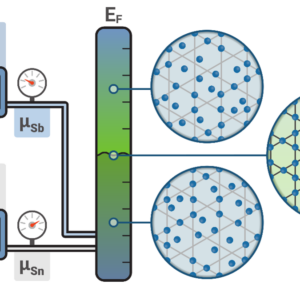
Scientific Achievement: Established new family of magnetically tunable, cleavable kagome metals by combining chemical substitution, electron filling, and magnetic properties to develop new intermetallic phases.Significance and Impact: Introduces a new synthetic strategy for stabilizing and tuning complex quantum materials, opening new routes to discover Kagome metals with controllable magnetic and electronic properties.DOI: 10.1021/jacs.6c06163
Scientific Achievement: Exsolution behavior in high-entropy oxides (HEOs) were rationally tuned through coupled lattice- and valence-engineering, resulting in a highly active and selective catalyst for acetylene semi-hydrogenation to ethylene.Significance and Impact: This work establishes entropy-enabled lattice and valence engineering as a facile route to programmable exsolution for enhanced catalysis in diverse processes such as dry reforming of methane or reduction of alkynes to olefins.DOI: 10.1002/anie.9920205
Scientific Achievement: Phase-field modeling and mesoscale imaging reveal that surface wettability and temperature control whether water condenses as isolated droplets or uniform films on magnesium oxide (MgO), directly determining the texture of the resulting hydroxide precipitates.Significance and Impact: Understanding water-driven reaction mechanisms is critical for optimizing MgO's performance in energy applications, for example in microelectronics.DOI: 10.1039/d6ce00207b
Scientific Achievement: Using polycrystalline beryllium as a test case, researchers demonstrated that dynamic electron correlations can be probed directly with inelastic x-ray scattering.Significance and Impact: This work establishes a new experimental approach for directly measuring dynamic electron correlations in solids, enabling critical tests of theoretical predictions in a field that has traditionally relied on theory.DOI: 10.1103/vzrc-5m39
Scientific Achievement: Discovered unique ferromagnetic crystals with strong anisotropy by combining the magnetism of chromium with the strong spin-orbit coupling of gold.Significance and Impact: This work provides understanding of a new anisotropic ferromagnet and introduces a new crystal chemistry that may enable versatile metallic magnets for spintronics.DOI: 10.1021/acs.chemmater.6c00999
AI is transforming particle accelerator operations and design. ORNL is advancing AI assistants and autonomous control tools, including Osprey, to help operators access machine parameters faster and support more reliable, intelligent operations across DOE facilities.
ORNL is developing AI-powered digital twins for the Material Plasma Exposure eXperiment (MPEX) to accelerate the discovery and qualification of materials capable of withstanding the extreme conditions inside future fusion power plants. By combining simulations, experimental data, and autonomous control systems, the approach aims to shorten the path from facility construction to scientific discovery while advancing critical fusion energy technologies.
Photon is an AI vulnerability discovery framework designed to rapidly identify and assess weaknesses in large AI models at exascale, helping improve security and robustness before deployment. By automating large-scale testing and parallel attack simulations, Photon can reduce the time, cost, and expertise required to protect AI systems used in critical domains such as energy, healthcare, finance, and national security.
ORNL researchers demonstrated the first autonomous pulsed laser deposition (PLD) platform, combining AI, large language models and self-driving experimentation to rapidly synthesize and evaluate advanced thin-film materials. The approach accelerates materials discovery by up to 100 times, opening new opportunities for next-generation electronics, energy technologies and autonomous research laboratories.
ORNL researchers are using AI and machine learning to accelerate nuclear physics analyses, reducing experimental time and costs while improving the speed and accuracy of measurements critical to energy, national security, and scientific discovery.
What if a 3D printer could catch its own mistakes — and tell you instantly whether a part is good to use? Peregrine is an AI-enabled technology that brings greater intelligence to metal additive manufacturing.
ORNL’s Advanced Plant Phenotyping Laboratory and Frontier exascale supercomputer provide the ideal environment to apply AI for enhancing plant uptake of critical minerals using engineered proteins and microbes from national laboratory partners