Since 2010, DOE’s Office of Science has helped to expand and invigorate the nation’s scientific workforce by supporting 785 young scientists at universities and national laboratories through its Early Career Research Program. This year, three ORNL scientists were among the 83 selected to receive ECRP awards.
Elizabeth Herndon has already worked in a variety of environments, focusing her research on how soil minerals affect the storage or release of organic matter and nutrients in various ecosystems.
"When I was an undergraduate, my major was mathematics,” Guannan Zhang said, “but when I went to graduate school, I got into programming and other aspects of computing, so it was very natural for me to pursue a Ph.D. in computational mathematics.”
ORNL physicist Libby Johnson, one of the world’s first nuclear reactor operators, standardized the field of criticality safety with peers from ORNL and Los Alamos National Laboratory.
An ORNL team has tackled the challenge of detecting nuclear materials in vehicles by combining radiation detection with seismology, typically used to study earthquakes.
Pulitzer Prize-winning author Kai Bird recounted the effort to right a wrong committed against one of the science icons of the twentieth century — the revocation of the security clearance of Robert Oppenheimer.
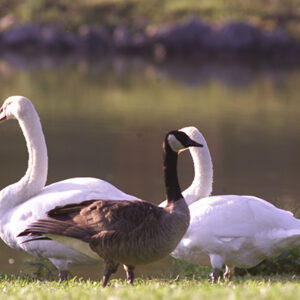
The Conference Center Pond, as it is now called, provides the Laboratory’s main campus with a scenic water feature. The pond’s beginning goes back to the summer of 1961, and its creation was essentially a practical matter.
Computational researchers from ORNL are working with a Cincinnati children’s hospital to better predict and address mental health disorders in children.
The ORNL biochemist and civic leader proposed that President Eisenhower’s 1953 executive order to desegregate Army base schools include those under the Atomic Energy Commission, as well.