How did the Oak Ridge Leadership Computing Facility and its vendor partners AMD and HPE Cray overcome the daunting obstacles that stood between them and the world's first exascale supercomputer? It took a lot of organization, several false starts and some fortuitous advances in computing technology.
As renewable sources of energy such as wind and sun power are increasingly added to the country’s electrical grid, old-fashioned nuclear energy is also being primed for a resurgence.
Ensuring Frontier runs as advertised spanned two fronts: the hardware and software, handled mainly by the Operations Section, and the codes developed to run the various simulations, handled mainly by the Scientific Engagement Section.
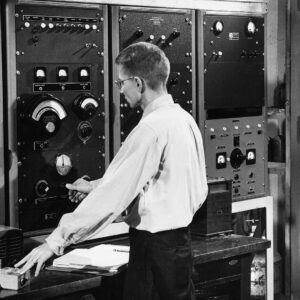
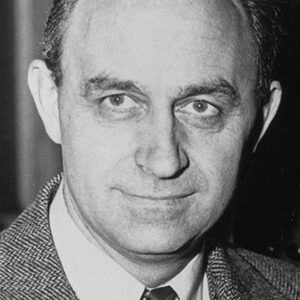
ORNL’s beginnings as an East Tennessee-located national laboratory have their roots in Chicago. That’s where the Nobel laureate Enrico Fermi (1938) and a host of physicists and engineers constructed CP-1, the first nuclear reactor: a “pile” of graphite blocks and control mechanisms in a disused squash court at Stagg Field on the University of Chicago campus.
In 1942, Katharine (Kay) Way was teaching physics at the University of Tennessee when a former professor recruited her to join the top-secret Manhattan Project at the University of Chicago.
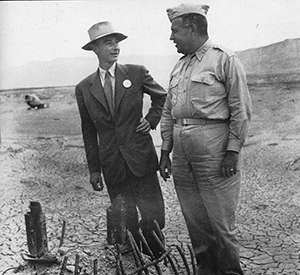
A discussion of the history of the Manhattan Project, focusing largely on the project’s military director, Gen. Leslie B. Groves, and the scientific director, Robert Oppenheimer, keynoted ORNL’s observance of its 80th anniversary.
The Advanced Neutron Source was to be ORNL's next hallmark research reactor, but the project did not go forward. Instead, an accelerator-based neutron source was proposed.
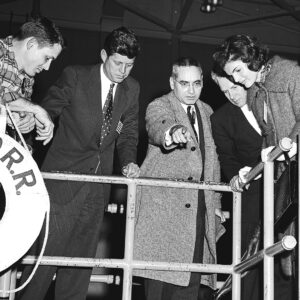
As ORNL and its historic landmark Graphite Reactor mark their 80th year, another of the Lab's storied nuclear reactors is seeing a milestone birthday: The Oak Ridge Research Reactor, situated in the oldest part of the Lab campus, first went critical 65 years ago, in March 1958.
In the late 1940s, ORNL (known then as Clinton Laboratories) was making the conversion from its wartime mission to a center for scientific research and isotope production. If ORNL was going to endure, it needed robust and modern facilities.