Facilitating Growth of Marine Energy Technology through TEAMER
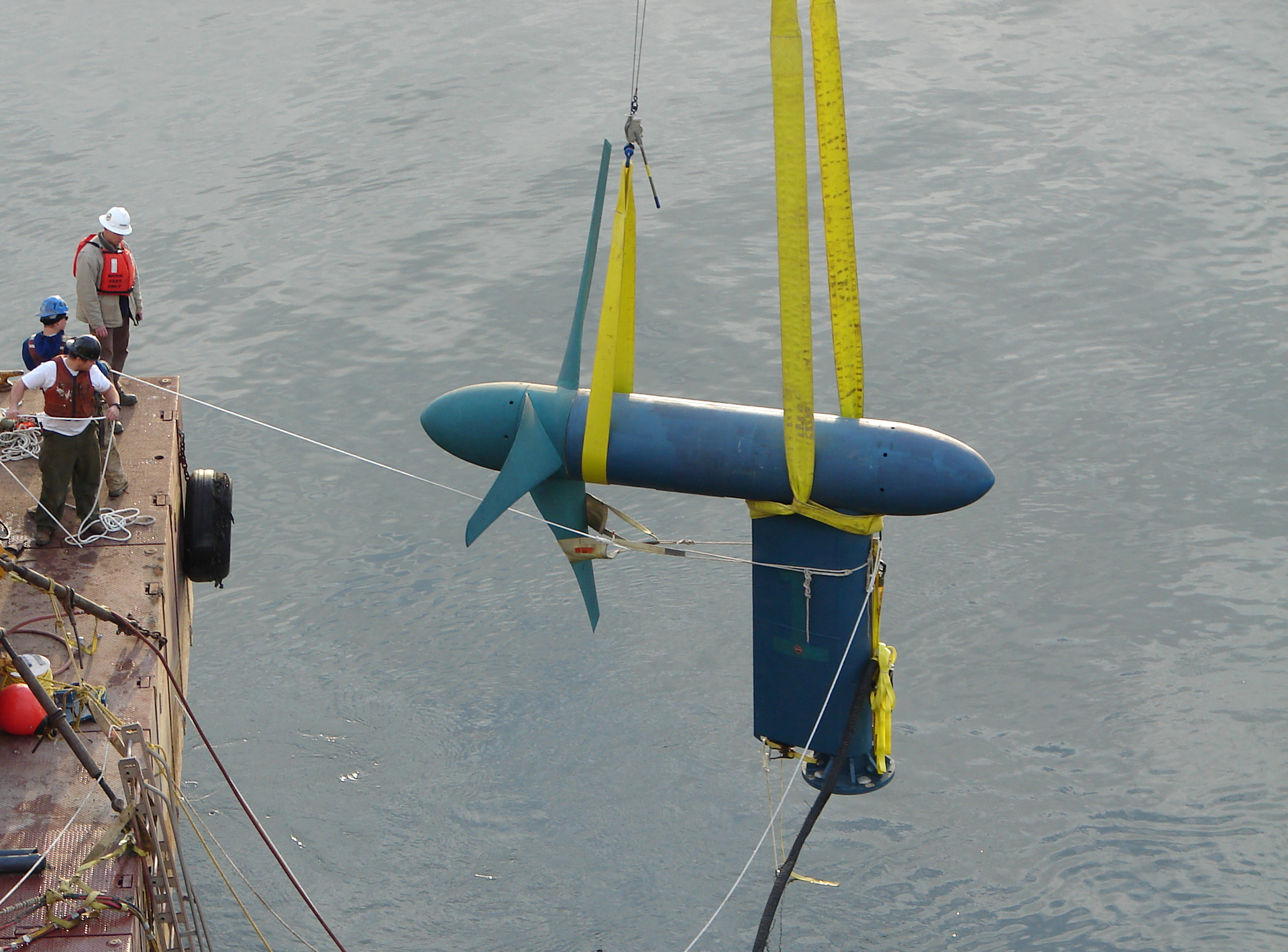
Installation of Verdant Power Tidal Turbine at RITE Project. Credit: Verdant Power
Overview/Objective
Marine energy, the energy harnessed from the motion of waves and currents, relies on emerging technologies that have the potential to expand the nation’s energy sector. To develop innovations that can be successfully brought to market and to the power grid, the U.S. Department of Energy’s (DOE’s) Hydropower and Hydrokinetic Office (H2O) has implemented TEAMER, or the Testing Expertise and Access for Marine Energy Research program.
The multi-year, $25 million program, directed by the Pacific Ocean Energy Trust, offers open funding calls for marine energy developers seeking to test their technologies. TEAMER’s goal is to provide applicants access to world-class user facilities, technical expertise, and testing capabilities offered across a national network of universities and national laboratories.
Impact
As the DOE’s largest science and energy laboratory, Oak Ridge National Laboratory (ORNL) boasts a network of user test facilities, whose extensive capabilities help drive and validate new technologies and innovations.
ORNL Capabilities and Expertise
Manufacturing Demonstration Facility
The Manufacturing Demonstration Facility (MDF) can help reduce manufacturing costs and increase the durability of materials, thus reducing the levelized cost of energy, a significant obstacle to bringing marine energy technologies to market. The MDF has collaborated with several energy companies, using 3D printed molds and additive manufacturing to create turbine components and proposing materials that are resistant to corrosion and biofouling.
Oak Ridge Leadership Computing Facility
Home to the world’s first exascale supercomputer, Frontier, the Oak Ridge Leadership Computing Facility (OLCF) can address and employ a range of numerical simulations applicable to marine energy problems, using either off-the-shelf computational fluid dynamics software or developing custom scalable codes. Relevant simulations include turbine hydrodynamics and design optimization, fluid-structure interaction modeling, smooth particle hydrodynamics, environmental modeling, and mooring dynamics simulation.
Aquatic Ecology Laboratory
Recent studies conducted at the Aquatic Ecology Laboratory (AEL) have focused on turbine blade fish strikes, magnetic field interactions, and environmental sound characterization. The AEL is now leading studies on the toxicity of biofouling agents and a new generation of ionic liquids used as environmentally acceptable lubricants. The AEL can also develop individual-based models to estimate population-level consequences and risk to marine species posed by marine energy technologies.
Grid Research Integration and Deployment Center
Marine energy scientists can conduct micro-grid simulations at the Grid Research Integration and Deployment Center (GRID-C) on marine energy applications in isolated and underserved communities, simulate and test electronic interconnections, secure engineering support on control systems, and test advanced sensors for health and environmental monitoring.
National Transportation Research Center
Capabilities provided by the National Transportation Research Center (NTRC) can be leveraged to test turbines, powertrain systems, power electronics, and batteries for energy storage. Other equipment and capabilities include dynamometers, hardware-in-the-loop systems, generator testing, power performance modeling, and power take-off testing.
Next Steps
To collaborate with ORNL, contact Jiyong Lee to learn more about ORNL user facilities and testing capabilities. Then apply on the TEAMER website.
Novel Eco-Friendly Lubricant Additives for Marine Turbomachinery
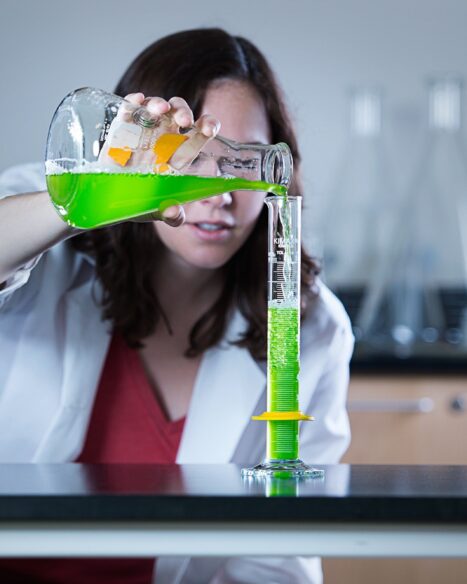
Wenbo Wang, a postdoctoral researcher with the Surface Engineering and Tribology Group at the Physical Sciences Directorate, tests the lubricity of ionic liquids. Credit: Genevieve Martin/ORNL, U.S. Dept. of Energy
Overview/Objective
Marine energy leverages the natural movement of water like waves, tides, and river and ocean currents to generate electricity. Because these energy resources are predictable, they could be significant contributors to a stable, reliable electricity grid. Though marine energy devices have been developed, the field currently faces a few logistical challenges that hinder widespread adoption of this otherwise promising technology. One of them is that the lubricants used to keep the machinery running require chemical additives that are either toxic, and therefore could gravely contaminate the aquatic environment, or they are not effective.
To that end, scientists at Oak Ridge National Laboratory sought to design, synthesize and test nontoxic but high-functioning additives for use in turbines installed in aquatic environments. A team of materials science and environmental researchers saw potential in ORNL’s newly invented ionic liquids (ILs) of ammonium phosphate and phosphonium phosphate, organic liquid salts that mix well with oil, are stable in a range of temperatures and conditions, and reduce friction and wear for bearings and gears. They further focused in on ILs with hydrocarbon chains that contained fewer than six carbon atoms, which are generally considered to be less toxic.
The team was looking for a substance that consistently demonstrated the following properties:
High-performing from a lubrication standpoint
Nontoxic to aquatic organisms
Readily biodegradable
The candidate substances also had the advantage of being straightforward to manufacture and easily scalable for commercial use.
Results
To test the lubricating efficacy of the candidate additives, scientists at the Physical Sciences Directorate conducted friction testing with metal pieces designed to simulate turbine gears and bearings, then examined the pieces using electron microscopy at the Center for Nanophase Materials Sciences, a Department of Energy Office of Science user facility at ORNL. When added to base oils, the ILs demonstrated 50% less friction and a tenfold decrease in wear losses compared to a commercial gear oil.
The findings showed that the environmentally acceptable lubricant (EAL) base oils had no effect on the water fleas. On the other hand, commercial lubricant additives and two of the previous IL compounds were found to be toxic to the organisms, resulting in 100% mortality within one to three days of exposure. However, the organisms fared much better when exposed to new, short-chain ammonium phosphate and phosphonium phosphate ILs as EAL additives, showing 90 to 100% survival rates after seven days.
The top-performing IL-enhanced lubricants were also found to be inherently or readily biodegradable during preliminary tests.
Impact
The discovery of high-performing, environmentally friendly lubricant additives is important for the safe and sustainable growth of marine energy, but also could have a positive impact that extends far beyond this specific field.
According to the DOE, each year the U.S. consumes about 2.47 billion gallons of lubricating oil in engines, industrial machinery and other uses, both on land and at sea. About half of that oil eventually finds its way into the environment. ORNL’s research provides fundamental understanding that will aid future development of other eco-friendly ILs to be used in a wide variety of settings, which could ultimately result in a healthier, cleaner environment all around.
This team will next focus on further development of IL lubricant additives customized specifically for use in tidal turbines operating in the ocean, which are exposed to potential seawater contamination, corrosive conditions and pressure and temperature extremes.
This project was sponsored by the Vehicle Technologies Office, the Hydropower and Hydrokinetic Office (H2O), and the ORNL Technology Innovation Program, all of which ultimately fall under the auspices of the DOE.