Revealing adversaries and protecting privacy
The Human Analysis and Biometrics Group contributes to a number of national security priorities -- including facility security, forensics, human trafficking, and insider threats -- through research in biometric identification, identity analysis, and human behavior analysis.
We're a multidisciplinary team
We're a multidisciplinary team with diverse expertise focused on developing biometric systems that are accurate, secure, and respectful of privacy. To deliver our missions, we need dedicated researchers with expertise in computer vision, machine learning, electronics, imaging, human subject testing, and more!
In addition to these academic backgrounds, our team has expertise in algorithm development, data collection, and device prototyping.
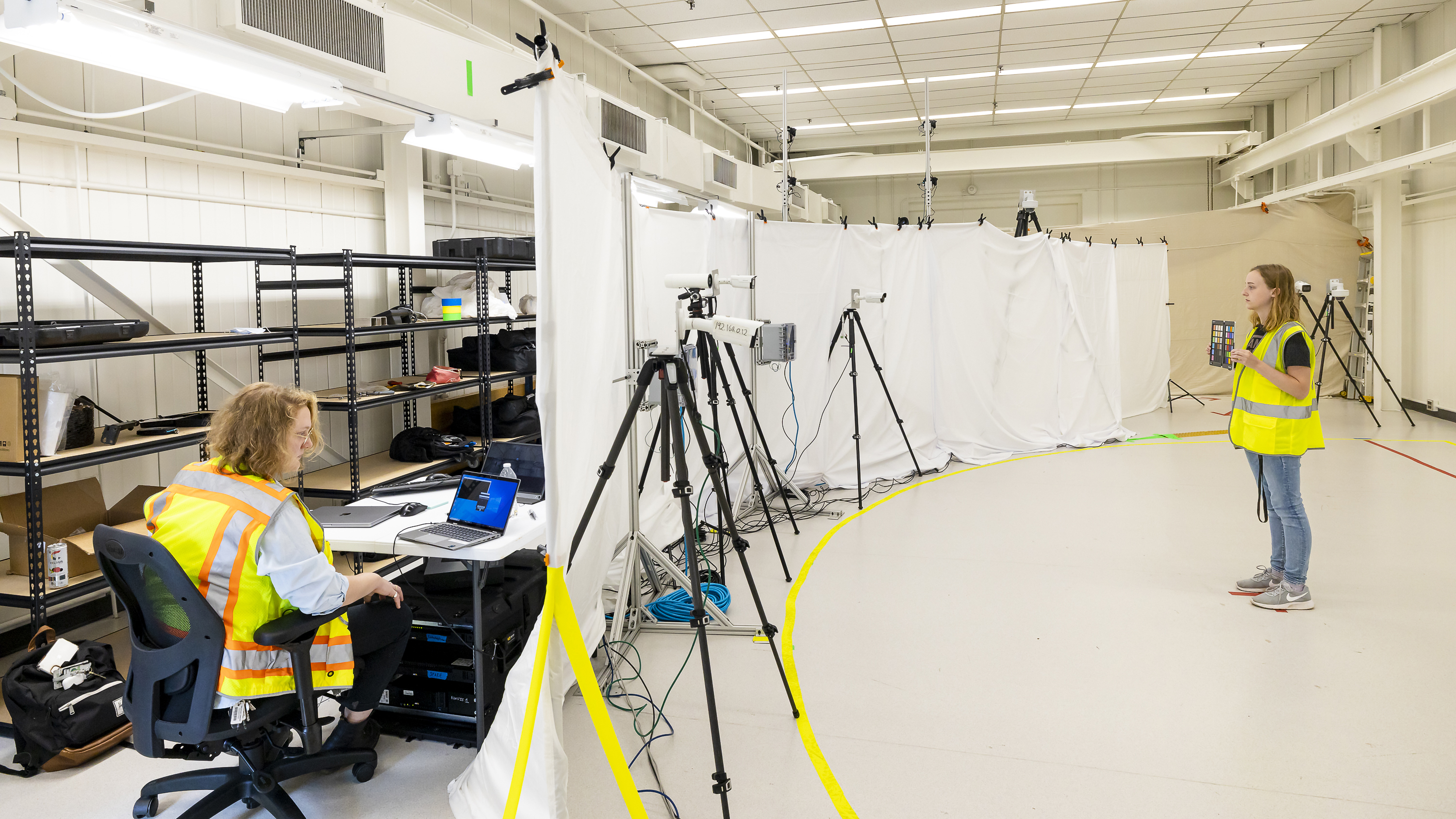
A lab designed for behavior analysis
The Human Analysis and Biometrics Labs
Primary research areas
The Human Analysis and Biometric group is at the forefront of developing and evaluating novel biometric systems that are transforming how identity is verified beyond traditional fingerprints and facial recognition to more advanced and subtle human characteristics. Our technologies often leverage artificial intelligence and machine learning to improve accuracy of biometric and human analysis systems over time, adapting to natural changes in a user’s behavior while still detecting anomalies.
Our group specializes in human data collection in natural conditions focused on understanding behavior as it occurs in real-world environments, providing richer context and greater validity than controlled laboratory studies. Our collections rely on complex camera setups, mobile devices, wearable sensors, and digital activity logs to passively collect data on movement, communication, and interactions over extended periods. This approach enables the discovery of authentic behavioral patterns and long-term trends that may not emerge in artificial settings.
Drawing from fields like adversarial machine learning and cybersecurity, we are researching methods for understanding and defending against attempts to deceive or manipulate biometric systems. Techniques such as presentation attacks (e.g., masks or synthetic fingerprints) and digitally generated inputs like deepfakes challenge the reliability of biometric models by introducing carefully crafted data designed to bypass detection. We are developing more robust algorithms that can detect anomalies, liveness cues, and subtle inconsistencies in biometric signals, increasing resilience.
Contact