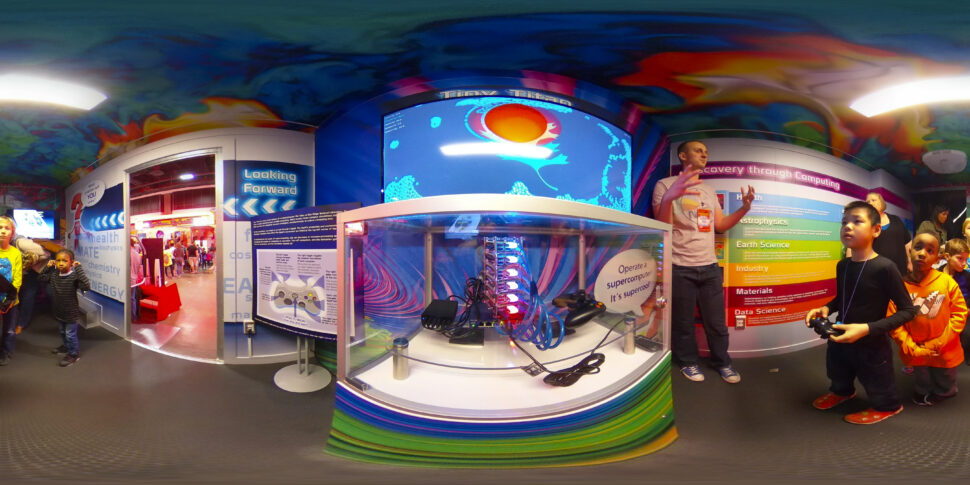
What’s Your Problem? introduces students to high-performance computing and the ways powerful computers can help researchers tackle complex scientific problems.
Through interactive experiences inspired by computing at Oak Ridge National Laboratory, students explore the evolution of supercomputers, discover how parallel computing divides large problems into smaller tasks, and experiment with concepts related to artificial intelligence.
What You’ll Do in the Exhibit
Students explore computing concepts through hands-on activities that demonstrate how computers can work together to solve complex problems.
In the exhibit, students can:
Discover how advanced computing can help researchers address complex scientific questions.
Explore the history of several ORNL supercomputers and see how computing technology has changed over time.
Step inside a mirrored infinity room to visualize the basic idea behind dividing work among many computing resources.
Use the Parallel Architecture Test Implementation (PArTI) to explore multicore and parallel computing.
See how adding computing cores can reduce the time required to complete calculations.
Compete against a computer in a timed activity related to artificial intelligence and image analysis.
Explore the Evolution of Supercomputing
Oak Ridge National Laboratory has been home to generations of powerful computing systems.
Interactive touchscreens introduce students to three systems from ORNL’s computing history—Phoenix, Jaguar, and Summit—and demonstrate how computing technology has advanced over time.
By exploring these systems, students can see how increasingly powerful computing resources have helped researchers address scientific problems at greater speeds.
Explore Parallel Computing
Complex problems can sometimes be solved more efficiently when work is divided into smaller tasks that can be completed at the same time. This concept is known as parallel computing.
The exhibit’s mirrored infinity room introduces this idea by asking students to imagine having many versions of themselves working together. How much faster could a job be completed if different tasks happened at the same time?
Students then put the concept into action using the Parallel Architecture Test Implementation (PArTI), a collection of computers designed to visually demonstrate multicore computing.
As students operate PArTI, they can see how distributing work across additional computing cores can reduce the time required to complete complex calculations.
Explore Artificial Intelligence
Artificial intelligence involves computer systems performing tasks using information and patterns found in data.
In the exhibit’s “future room,” students compete against a computer in a timed image activity. Participants examine multiple images of Summit and try to identify the image that differs from the others while the computer works on the same challenge.
The activity introduces students to concepts related to how computers can analyze information and perform certain tasks quickly.
Computing and Scientific Discovery
High-performance computing gives researchers powerful tools for investigating complex scientific questions.
The What’s Your Problem? exhibit shows students how computing technology, parallel processing, and artificial intelligence can contribute to scientific problem-solving and how advances in computing can expand what researchers are able to study.
Explore STEM Careers
Advanced computing brings together people with skills in computing, mathematics, data, scientific research, and other technical fields.
Through the exhibit, students encounter concepts involved in high-performance computing, parallel processing, artificial intelligence, and scientific problem-solving.
These experiences can help students see how computational skills contribute to scientific research and introduce them to educational and career pathways connected with computing and technology.