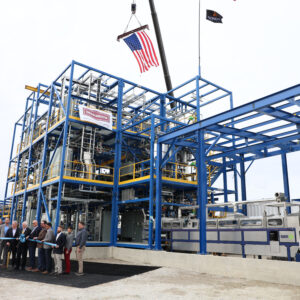
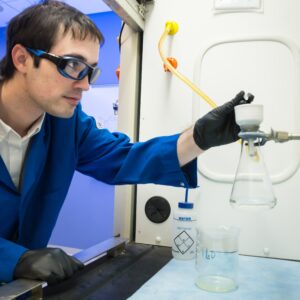
ORNL and ACP Technologies have partnered for more than seven years to advance pitch-based materials for carbon fiber and synthetic graphite production, helping move the technology from laboratory research to pilot-scale manufacturing. Through work at ORNL and the Carbon Fiber Technology Facility, ACP refined its mesophase pitch materials and established a new pilot production facility in Kentucky, with a commercial-scale plant planned for 2029. The collaboration supports domestic supply chains for energy storage, transportation, aerospace, and defense applications.
A research agreement between ORNL and Louisiana State University will accelerate energy generation and critical materials manufacturing and enhance job growth in the fuel and chemical industries, particularly in the Gulf Coast region.
Oak Ridge National Laboratory (ORNL) will collaborate with industrial partners on two projects under the latest round of awards by the U.S. Department of Energy (DOE) as part of its High Performance Computing programs to support the manufacturing industry and to help develop advanced materials. I...
To improve models for drilling, hydraulic fracturing and underground storage of carbon dioxide, Oak Ridge National Laboratory scientists used neutrons to understand how water flows through fractured rock.
Oak Ridge National Laboratory (ORNL) researchers in multiple disciplines recently paid a field visit to exploration and production company Pioneer Natural Resources as part of a new Technologist in Residence (TIR) program. The Department of Energy’s (DOE) Office of Energy Efficiency and Renewable...
Scientists at the Department of Energy’s Oak Ridge National Laboratory have found a simple, reliable process to capture carbon dioxide directly from ambient air, offering a new option for carbon capture and storage strategies to combat global warming. Initia...
In a new twist to waste-to-fuel technology, scientists at the Department of Energy’s Oak Ridge National Laboratory have developed an electrochemical process that uses tiny spikes of carbon and copper to turn carbon dioxide, a greenhouse gas, into ethanol. Their findin...
from ORNL Review, vol 49, no 3, 2016 The ingredients that make geothermal energy suitable for electricity production are simple: heat, permeability (usually fractured rock) and water. Until recently the trick has been finding all in the same place and in the right amounts. ...