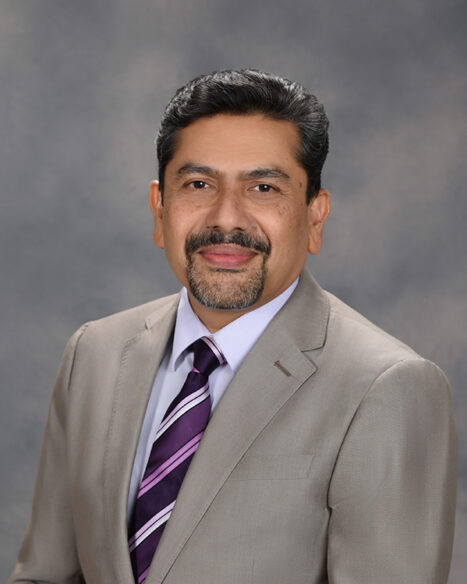
Long before Sunil Chirayath became a distinguished R&D scientist at the Department of Energy’s (DOE) Oak Ridge National Laboratory (ORNL), he was journeying to Oak Ridge, Tennessee, with students as a professor at Texas A&M University (TAMU). Chirayath and a colleague would leave College Station before dawn, driving until dark to spend the next week leading university students through hands-on exercises in ORNL’s safeguards laboratory.
As a user of ORNL’s High Flux Isotope Reactor, Chirayath worked with his team to irradiate uranium fuel pellets that would be taken back to Texas for radiochemical separation and analysis.
“My first real experiment for radiochemistry happened at ORNL,” he said.
The experience brought together the parts of nuclear science that have defined his career: understanding reactors, measuring nuclear material and helping others learn the field.
Years later, ORNL offered something more: the chance to move beyond periodic visits and build the next stage of that career inside a national laboratory.
Learning to see the whole nuclear system
Chirayath often explains his career through what the nuclear field calls the “three S’s”: safety, security and safeguards. The first “S,” safety, defined his early career work in his home country of India. Beginning in the early 1990s, he worked for India’s Atomic Energy Regulatory Board (AERB), reviewing reactor-core physics, radiation protection and nuclear fuel-cycle facilities with the objective regulatory enforcement. He also contributed to the design analysis for the country’s prototype fast breeder reactor.
The work required him to understand how fuel behavior, reactor operations, radiation safety and regulation affected one another. This systems perspective became essential as his attention expanded to the other two S’s, safeguards and security, and he transitioned from preventing accidents to preventing the theft, diversion or misuse of nuclear material.
After 17 years with AERB, a nonproliferation and security research initiative associated with U.S.-India civil nuclear cooperation brought Chirayath to TAMU. He and his family relocated to the United States when his children were five and nine, a move that upended even familiar routines — think driving on the opposite side of the road.
“Moving to the U.S. was a cultural shock,” he said.
Proliferating opportunities for a future nuclear workforce
At Texas A&M, Chirayath wasted no time building better opportunities for current and future nuclear scientists. When he saw TAMU nuclear engineering students had few opportunities to learn radiochemistry, he led a research proposal for over $2 million from the Department of Homeland Security under the Academic Research Initiative, jointly with National Science Foundation. The department won the grant, and Chirayath established a radiochemistry and pre-detonation nuclear-forensics laboratory in collaboration with a professor from Texas A&M Department of Chemistry. This allowed students to bring concepts they’d learned about in textbooks and lectures to life. They could work directly with irradiated uranium materials and use isotopes, including plutonium and trace elements to reconstruct a material’s history: the type of reactor that produced it, how long the fuel was irradiated, and how long ago the fuel was irradiated.
The investment also created a pipeline of people, many of whom progressed into national laboratories, universities, and industry. His team also developed introductory online courses in nuclear science, security and safeguards, open to anyone.
“We created a light-touch version of the graduate courses we were teaching for the general public,” he said. “They can take basic nuclear science courses, nuclear security courses and nuclear safeguards courses.”
Throughout his time at TAMU, Chirayath grew from a postdoctoral fellow into a tenured full professor and director of the university’s Center for Nuclear Security Science and Policy Initiatives.
Why ORNL?
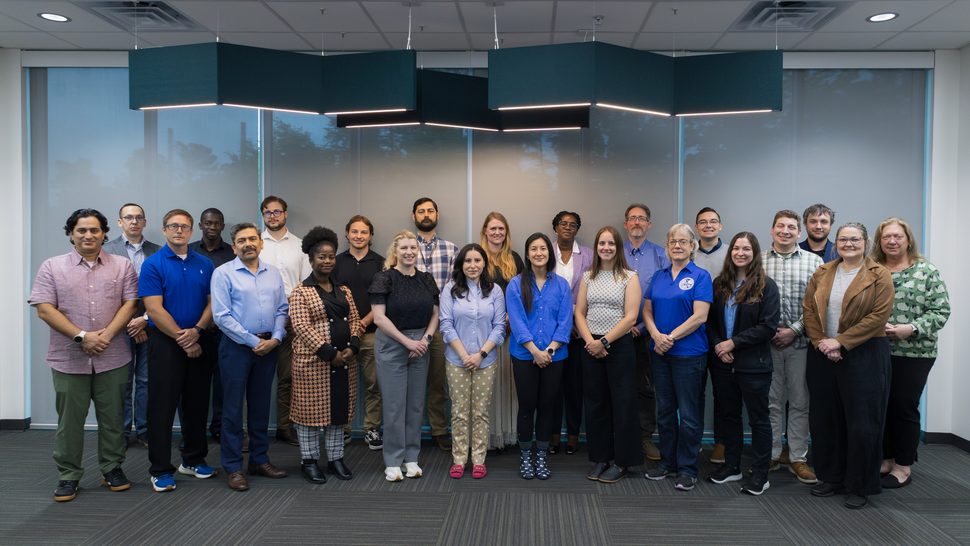
ORNL has been a steady presence in Chirayath’s career, through professional societies, research collaborators, former students and, of course, the pilgrimages he made to help students access opportunities they otherwise may not have had. Making ORNL a permanent fixture in his career path required professional opportunity and personal timing. He applied for a position at the lab after gaining his U.S. citizenship, a process that took more than a decade and opened the door to clearances required for the job.
The decision was driven just as much by his desire to progress research and development into higher technology readiness levels — in other words, to help develop mission-ready technologies. ORNL offered the facilities, technical teams and mission relationships to mature those ideas — and to test them against real materials and operational needs.
National laboratory work with international impact
Today, Chirayath is a Distinguished R&D Scientist and leads ORNL’s Nondestructive Measurement Science and Technology Group. The group develops ways to identify and quantify nuclear material sealed inside containers or operation systems by measuring signatures such as gamma rays and neutrons.
The position places Chirayath at the intersection of measurement science, reactor modeling, nuclear data and nonproliferation. It also connects him with colleagues across reactor physics, radiochemistry, instrumentation, computation and policy within a laboratory built for multidisciplinary work.
One example is the $5 million Proliferation Resistance Optimization for Advanced Reactors and Fuel Cycles (PRO-AR&FC) program he co-leads with Senior Science and Technology Staff Scientist Karen Hogue. The team is developing a consistent, primarily quantitative way to evaluate whether the intrinsic features of emerging reactors make nuclear material production more difficult to misuse – and whether designers can improve those features without undermining reactor performance. It is one project within a broader portfolio that includes material control and accountancy, monitoring for molten-salt reactors, international nuclear security engagements, nonproliferation stewardship program, nuclear forensics, and international and domestic safeguards modeling.
“Our PRO-AR&FC program looks at, before we apply security or safeguards, are there opportunities to reduce the proliferation risk?” Chirayath said, harkening back to his days in India working on reactor safety.
ORNL’s facilities and people can help move the program’s methods closer to use. Its facilities make experimentation possible, its workforce allows modeling and measurement to inform each other, and its sponsor relationships connect the science to national and international needs.
“Once we assess the intrinsic proliferation resistance of a reactor, we might be able to recommend ways to optimize the design by improving proliferation resistance without affecting the reactor performance,” he said.
Building teams, developing people
Chirayath describes his leadership style simply: “Work with people instead of a top-to-bottom approach.” This is visible in the career he has built. In India, he learned to weigh the interactions within complex nuclear systems. At Texas A&M, he created laboratories and courses so others could enter the field. At ORNL, he is focused on strengthening both his group’s technical capabilities and the team of researchers and professionals behind them.

That perspective also shapes his service to the broader community in professional societies, including the American Nuclear Society and the Institute of Nuclear Materials Management. He was recently honored with the Leadership Award from ANS and elected to Vice President (President Elect) of INMM.
Each chapter of Chirayath’s career, while varied in geography and scope, has further expanded the same mission: helping society use nuclear technology while understanding and managing its risks.
UT-Battelle manages ORNL for DOE’s Office of Science, the single largest supporter of basic research in the physical sciences in the United States. The Office of Science is working to address some of the most pressing challenges of our time. For more information, please visit energy.gov/science.