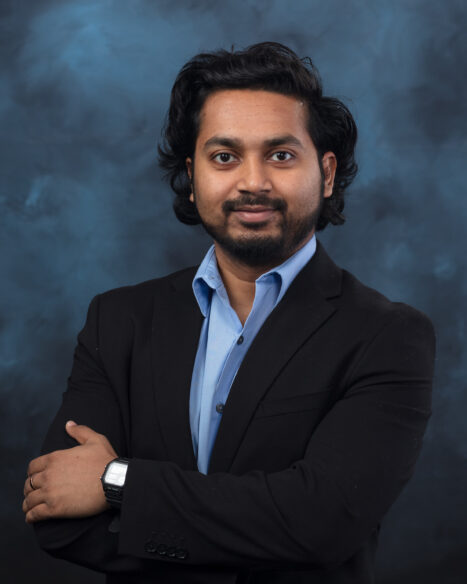
Dr. Sanjay Das is a Postdoctoral Research Associate at Oak Ridge National Laboratory (ORNL). His research interests span AI for Science and Operations, Scientific Hypothesis generation/evaluation and efficient AI. His work focuses on developing reliable and grounded AI systems for scientific hypothesis generation, operational and chemical safety, and complex mission-critical workflows.
Das develops AI-driven methods that bridge machine learning with underlying hardware and computing systems to improve the robustness, reliability, efficiency, and security of AI models. His research has investigated adversarial vulnerabilities in deep neural networks and large language models, hardware-induced faults and bit-flip attacks, quantized neural networks, AI accelerator reliability, and machine-learning-driven functional safety. More broadly, he explores the safe integration of advanced AI technologies, including large language models, multimodal AI, retrieval-augmented generation, knowledge-graph reasoning, agentic systems, and continual learning, into complex scientific and operational environments. His research vision is to enable AI systems that are not only capable, but also efficient, robust, interpretable, grounded, and safe to deploy.
Das has published research in venues including Transactions on Machine Learning Research (TMLR), ACM/IEEE Design Automation Conference (DAC), IEEE Symposium on Hardware Oriented Security and Trust (HOST) and IEEE VLSI Test Symposium (VTS). His work has addressed topics ranging from adversarial bit-flip attacks and DNN vulnerabilities to graph learning for fault criticality analysis, functional safety, and reliability of AI-enabled hardware systems. He actively contributes to the research community as a reviewer for conferences and journals spanning AI, computer architecture, hardware security, VLSI, NLP, and computer vision, including DAC, ICCAD, ASP-DAC, CVPR, EACL, IJCNLP-AACL, VTS, SOCC, ICPADS, DCAS, and IEEE TVLSI.
Das received his Ph.D. in Computer Engineering from The University of Texas at Dallas in 2025, where he worked on hardware security, AI robustness, and functional safety. He received his M.S. in Electrical and Computer Engineering from North Dakota State University in 2022 and his B.Tech. in Electrical Engineering from RCC Institute of Information Technology, India, in 2019. He is a member of IEEE, ACM, where he engages in extensive volunteering activities.
Links
Publications
Aug, 2026
Conference Paper
Enhancing Operational Safety via Agentic Dialogue Hazard Identification Analysis