
Breakthroughs in medicine, energy, technology, and industry follow advances in the understanding of materials. Oak Ridge National Laboratory (ORNL) is at the US epicenter for one of the most powerful techniques exploring the nature of materials and energy—neutron scattering.
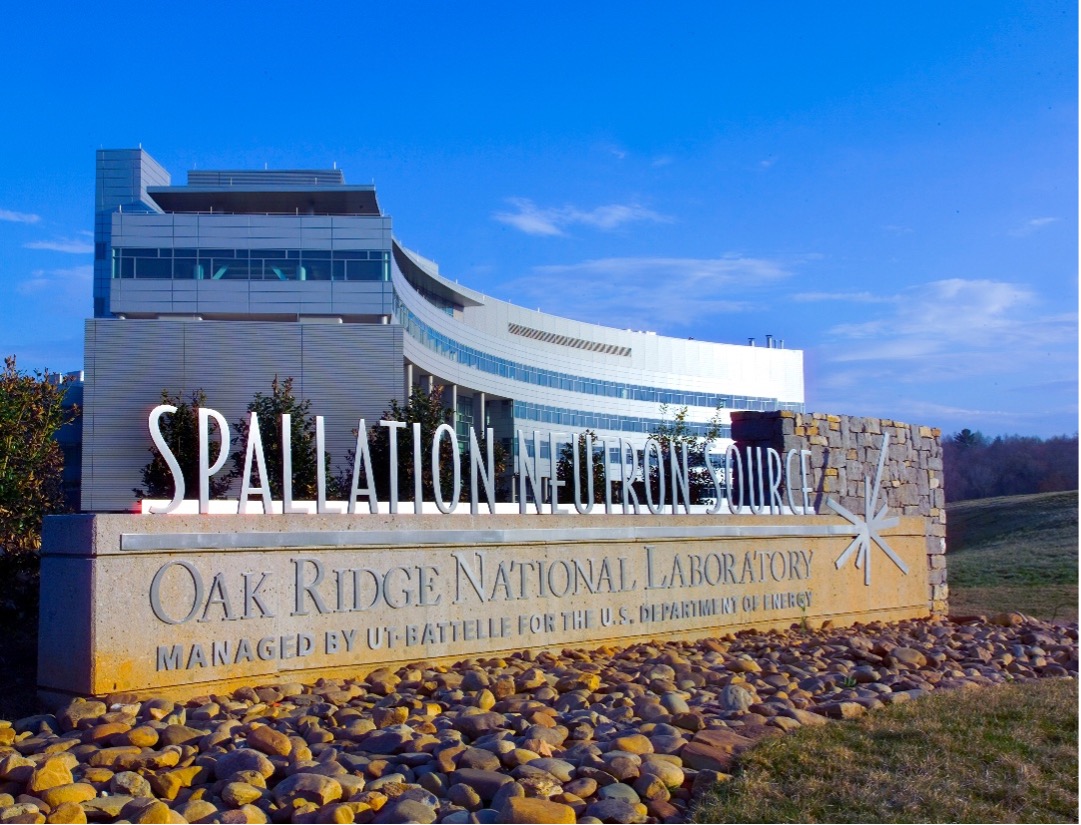
The Spallation Neutron Source (SNS) is one of two the world’s most powerful sources of neutrons for research. In April 2026, the SNS celebrates 20 years of safe operations and scientific achievements.
Co-located at ORNL with the High Flux Isotope Reactor (HFIR), the SNS produces neutrons with an accelerator-based system that delivers short (microsecond) proton pulses to a steel target filled with liquid mercury through a process called spallation. Those neutrons are then directed toward state-of-the-art instruments that provide a variety of capabilities to researchers across a broad range of disciplines, such as physics, chemistry, biology, and materials science.
With its more intense, brighter source of neutrons and world-class instrument suite, SNS provides the neutron scattering community with unprecedented research opportunities.
Neutrons have no electrical charge, which allows them to easily and safely pass through a sample, revealing information about the material’s structure and properties.
Research at the SNS strengthens America through discovery science enabled by multidisciplinary teams and advances technologies to ensure secure, affordable, and reliable energy to fuel the nation’s economic growth and energy independence. It accelerates the transition of research into real-world applications to drive economic prosperity and give US industries an edge, and protects America’s future through scientific and technological breakthroughs that secure critical infrastructure and address emerging threats.
Learn more about how the SNS works here in this animation and see timeline, below, for some historical highlights.
A Little History on a Very Big Deal
1940s: Advent of neutron scattering
Neutron scattering grew from the nuclear science of the Manhattan Project during the 1940s at what is now Oak Ridge National Laboratory (ORNL).

(Photo Credit: ORNL/U.S. Dept. of Energy)

(Photo Credit: Jim Richmond/ORNL, U.S. Dept. of Energy)
Right: The Spallation Neutron Source, 2024.(Photo Credit: Percy Harrell/ORNL, U.S. Dept. of Energy)
1980s-1990s: US source for discovery science
Between the mid-1980s and 90s, the United States conducted a series of studies into the country’s need for major science facilities. It was decided to build a second neutron source at ORNL, one dedicated solely to neutron scattering.
The facility was designed and constructed by an ORNL-led team with significant contributions from Argonne, Brookhaven, Lawrence Berkeley, and Los Alamos national laboratories, as well as the Thomas Jefferson National Accelerator Facility.
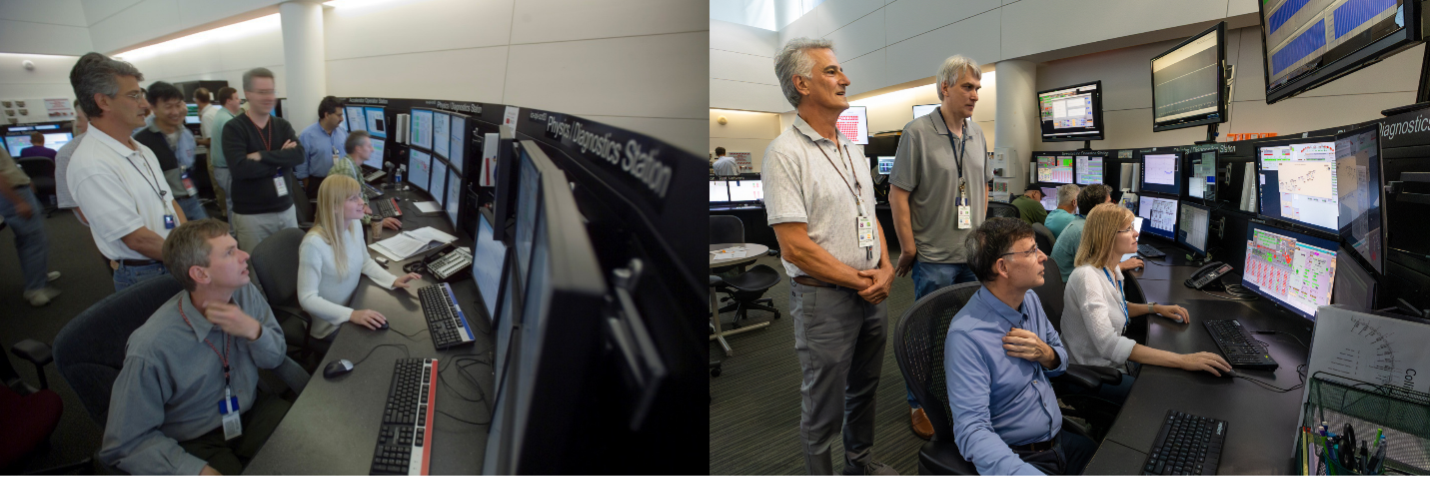
2006: First beams on target
SNS became operational on April 28, 2006, and sent the first proton beams to SNS’ mercury target, officially becoming a neutron source on time, on budget, on scope, and on target. Source.

(Photo Credit: Curtis Boles/ORNL, U.S. Dept. of Energy)
2008: A Guinness World Record: US source for discovery science
SNS is confirmed by Guinness World Records as the world’s most powerful pulsed neutron spallation source. The SNS ramped up beam power to more than 300 kilowatts for its original five instruments. Source.
2009: One megawatt of power
SNS, the world’s most powerful facility for pulsed neutron scattering science, became the first pulsed spallation neutron source to break the one-megawatt barrier. Source

(Photo Credit: Jason Richards/ORNL, U.S. Dept. of Energy)

2010: Gordon Battelle Awards
The High Flux Isotope Reactor and SNS figured in two of the five 2011 Gordon Battelle prizes for scientific discovery. Awards were presented to ORNL teams for the discovery of element 117, which used isotopes created at HFIR, and for groundbreaking studies of iron-based superconductors conducted on triple-axis spectrometers at HFIR and the ARCS (Wide-Angular Range Chopper Spectrometer) instrument at SNS. ORNL applied its distinctive capabilities in neutron scattering, chemistry, physics, and computation to detailed studies of the magnetic excitations of iron-based superconductors (iron pnictides and chalcogenides), a class of materials discovered in 2008. Source.
2014: Full power at 1.4 megawatts
Eight years after construction and seven years after operations began, the SNS achieved the beam power for which it was designed: 1.4 megawatts. Even at lower power levels, the accelerator-based center for materials research set records, and scientists from around the globe flocked to Oak Ridge to do experiments with the richest source of neutrons available. Source.

2024: Proton Power Upgrade enables record-breaking power
The Proton Power Upgrade project doubled the power capability of the SNS linear accelerator, from 1.4 to 2.8 megawatts, to facilitate new types of experiments and discoveries.
The project included building a connector between the accelerator and the planned Second Target Station (STS) at SNS. Workers added about 3,000 square feet of concrete tunnel, which connects to the existing accelerator tunnel. Other construction tasks included associated structures, roofing, geomembrane liner, tunnel waterproofing, electrical, fire alarm, ventilation systems and controls. Source.