Motivation
Particle accelerators are strategic infrastructure to science, industry and medicine. AI is poised to transform accelerator operations, design, and how research is done at DOE (including the largest accelerators, among the most complex machines ever built), academia and industry.
Approach
- Develop and implement language interfaces, AI assistants, and information synthesis at unprecedented scale.
- Deploy AI-assisted-to-fully autonomous design and operations
with preventive fault detection and auto-fault-recovery . - Treats nation’s accelerator ecosystem as a single, intelligent system.
Impact
- Accelerate discovery, industrial and medical applications with enhanced, intelligent, automated operations and novel accelerator designs that deliver better beams (e.g., higher energy and precision).
S&T Challenge
- Addresses Enhancing Particle Accelerators for Discovery
- Impacts/synergies with Quark-to-Cosmos, Scientific Imaging, Fusion & Fission Energy, Microelectronics, Quantum, Autonomous Labs
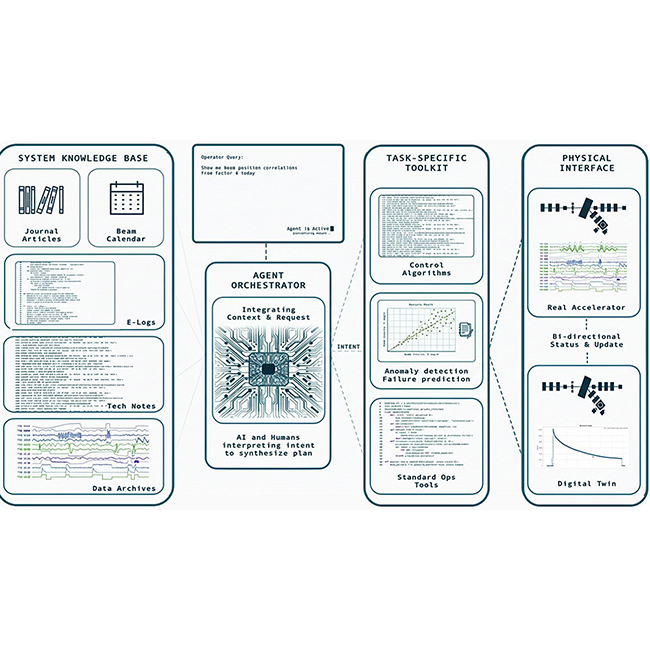
Agentic AI Osprey for accelerator operations
- Installed at 8 facilities in first phase
- Streamlines access to machine parameters for control (Millions of parameters when fully deployed)
- >100x faster operator queries & response for key activities
One codebase, eight sites, Genesis Mission’s infrastructure, a shared platform for transforming particle accelerators in the age of AI.