Oak Ridge National Laboratory’s (ORNL’s) Quantum Communications and Networking Group develops next-generation quantum communication technologies to create secure and resilient networks for critical infrastructure in the United States, with a focus on the power grid and metropolitan-scale quantum networks. The group’s research combines quantum physics, advanced optics, and computational methods to overcome real-world challenges in quantum networking and to protect vital national systems against current and future security threats.
The group’s overall mission focuses on several key areas:
- Practical quantum networking and security applications
- Critical infrastructure protection — especially power grids
- Real-world implementation challenges
- Forward-looking security perspective
- Balance of fundamental science and applied engineering
The Quantum Communications and Networking Group is at the forefront of developing quantum communication technologies to secure critical infrastructure in the United States and focuses on modernizing the power grid and building metropolitan quantum networks. The group’s work addresses a crucial challenge: as our electrical grid becomes increasingly connected and automated, it also becomes more vulnerable to cyberattacks. The group is pioneering quantum-based solutions to this security challenge.
The group’s research spans several innovative approaches. For example, researchers have conducted an extensive analysis of how quantum key distribution (QKD) could be applied to 18 different smart grid scenarios, thereby providing a practical roadmap for implementing quantum security in real-world power systems. The group has also made significant technical breakthroughs in quantum networking. For example, they have developed a polarization-agnostic method for continuous-variable QKD that eliminates the need for complex optical corrections, making the technology more practical for real-world deployment.
Particularly noteworthy is the group’s work on metropolitan quantum networks, in which they have demonstrated remarkable achievements in maintaining quantum connections over existing fiber infrastructure. Their automatic polarization compensation system has enabled continuous high-fidelity entanglement distribution with an impressive 94% accuracy over 30-hour periods. The group also developed innovative clock synchronization techniques that achieve sub-picosecond precision over 5.5 kilometers of fiber — a crucial capability for coordinating quantum communication systems across city-scale distances.
The societal impact of this work could be transformative. As conventional encryption methods become vulnerable to advancing computational power and sophisticated attacks, the group’s quantum communication technologies offer a physics-based solution for securing critical infrastructure. Their practical approaches to implementing quantum security could help ensure the reliability of power grids, thereby protecting essential services that millions of Americans depend on daily.
Looking ahead, the group is positioned to bridge the gap between laboratory demonstrations and real-world quantum networks. Their focus on addressing practical challenges while maintaining high performance means that they are working toward a future in which quantum-secured communications are an integral part of the United States’ protection strategy for critical infrastructure.
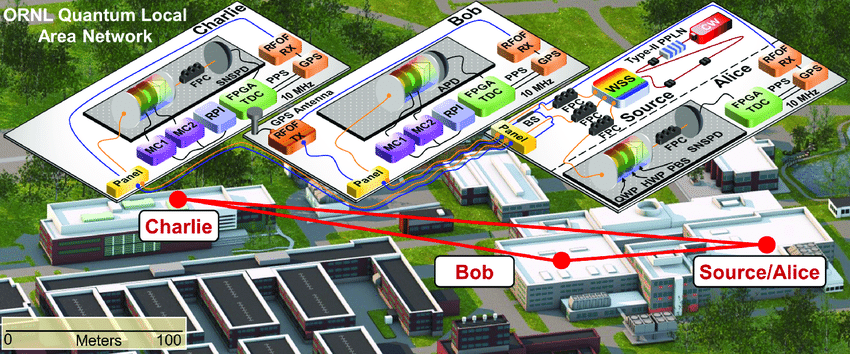
The Quantum Communications and Networking Group’s research experiments have enabled the extension of the Quantum Network Testbed into the longest (more than 300 kilometers) deployed “dark fiber” testbed for quantum networking in the national lab complex. The testbed supports 400-gigabit conventional data transfer speeds and
Tour Our Quantum Network Labs

Our research is supported by funding by the Department of Energy’s Advanced Scientific Computing Research (ASCR) program, DARPA, and ORNL’s internal awards.