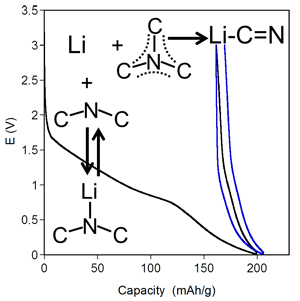
Reversible and irreversible binding sites have been identified in nitrogen containing carbonaceous lithium ion anode materials. This achievement will direct the search for new carbon-nitrogen materials for lithium-ion batteries and supercapacitors to focus on materials which exclude the nitrogen sites which irreversibly bind Li ions. In fact, this work showed that that addition of Li to graphitic carbon nitride (C
N
) leads to an irrersible reaction between Li and the graphite-like C
N species in C
N
, which are detrimental to the anode properties. Therefore, to boost electronic conductivity and reversibly cycle Li ions, suitable nitrogen-doped carbon structures for anode applications are predicted to need high concentrations of pyridinic C-N-C terminal bonds and low concentrations of quaternary C
N species. This result is particularly important for new energy technologies since carbon-nitrogen anodes have nearly twice the storage capacity of traditional graphite anodes. Increasing the capacity will increase the energy density of the battery facilitating electric vehicles with longer ranges or grid storage applications.
For more information, please contact Gabriel Veith, [email protected].