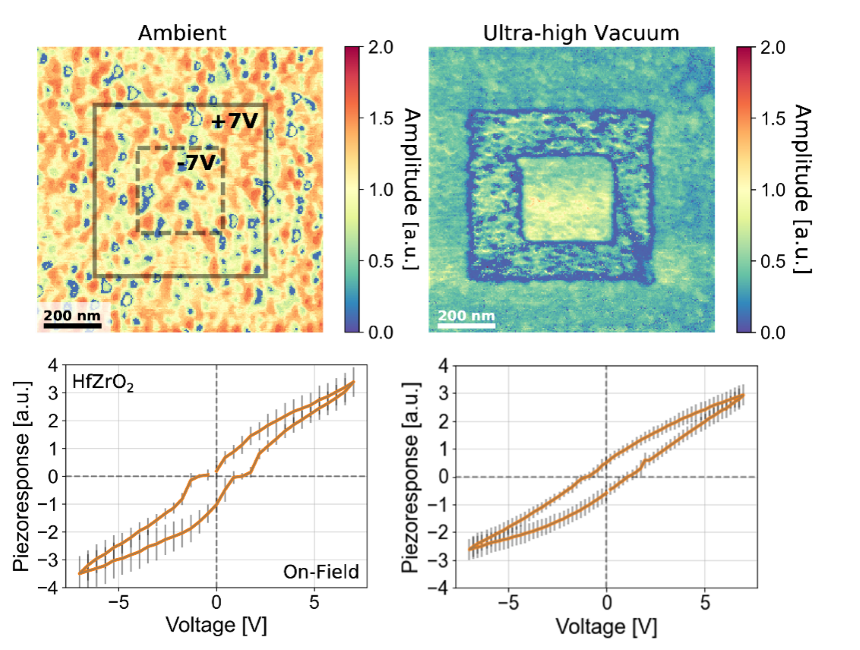
Scientific Achievement
Ferroelectric phenomena in hafnia, Hf0.5Zr0.5O2, emerged due to the interplay between ferroelectric and structural instabilities coupled with non-local screening mediated by the finite density of states at surfaces and internal interfaces.
Significance and Impact
Findings provide a pathway for predictive modeling and device engineering of hafnia, which is urgently needed given the importance of this material in the semiconductor industry.
Research Details
- Environmental piezoresponse force microscopy was used to trigger transitions between ferroelectric and antiferroelectric phases in Hf0.5Zr0.5O2.
Theoretical modeling confirmed that the observed behavior emanated from coupled antiferroelectric bulk and surface electrochemical phenomena.
K.P. Kelley, et al., Nature Materials 22, 1144-1151 (2023)
DOI: 10.1038/s41563-023-01619-9
Work conducted at the Center For Nanophase Materials Sciences
Related Researchers