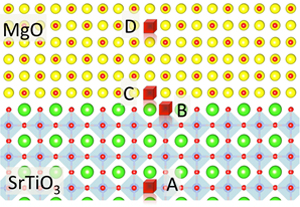
Density functional theory (DFT) calculations show that among the four types of (001) SrTiO
| (001) MgO interface structures, the TiO
-terminated SrTiO
containing electrostatically attractive Mg
O and Ti
O ion
ion interactions form the most stable interface. These calculations also predict that oxygen vacancies are most stable in the tensile-strained material, and unstable in compressive-strained material. This stability is due to the larger volume provided by tensile strain, thus accommodating the chemical expansion of the oxygen vacancy. Furthermore, the stability/concentration of the oxygen vacancies can be manipulated across the interface via interfacial strain.
In the past decade, material interfaces, particularly in oxide materials, have shown strikingly novel properties. These properties are largely attributed to the presence of interfacial strain and oxygen vacancies. Understanding the interfacial structure and vacancy stability is crucial to gaining control over materials design for future applications. These DFT calculations show that the location of oxygen vacancies could be precisely controlled by varying interfacial strain with a promise to impact variety of applications such as fast-ion conductors, superconductivity, ferromagnetic and ferroelastic applications. Vacancies and other defects at interfaces can be manipulated by ion beam modification process, and nanoscale heterointerfaces can be created by the passage of ions through materials.
D. S. Aidhy, Y. Zhang, and W. J. Weber, “(001) SrTiO3 | (001) MgO Interface and Oxygen-Vacancy Stability from First-Principles Calculations,” ACS Appl. Mater. Interfaces 6, 15536-15441 (2014). DOI: 10.1021/am504306t
For more information