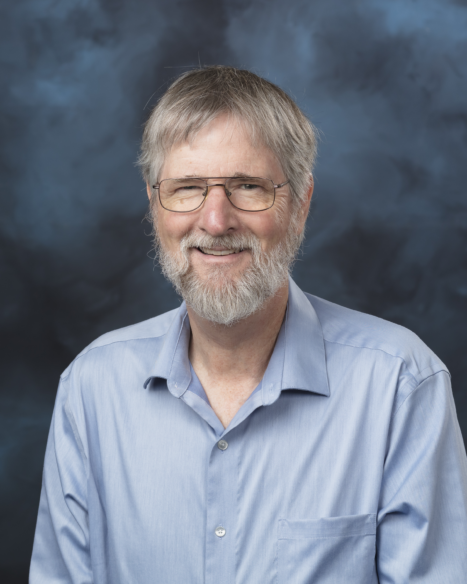
Gary Staebler, distinguished R&D scientist at the Department of Energy’s (DOE) Oak Ridge National Laboratory (ORNL), has been selected by the American Physical Society (APS) as a team of four recipients of the 2026 Lev D. Landau and Lyman Spitzer Jr. Award for Outstanding Contributions to Plasma Physics. The other team members are Ron Waltz of General Atomics in the U.S., Clarisse Bourdelle of CEA in France and Jonathan Citrin of Google Deepmind in the United Kingdom.
The APS award recognizes researchers for significant theoretical, experimental or technical contributions to plasma physics and for strengthening collaboration between Europe and the United States through joint research endeavors. Staebler was cited by APS “for advances in developing models that provide accurate and fast predictions for turbulent transport in tokamak plasmas, through more than a decade of collaboration that spans foundational quasilinear gyrokinetic theory, multi-device experimental validation and machine learning methodology.” As part of the award, Staebler will co-deliver an invited talk at the APS Division of Plasma Physics Annual Meeting in November in Chicago.
Staebler, who was elected as an APS Fellow in 2011, is known for his leadership role in developing physics-based models that help scientists predict turbulence in magnetically confined plasmas. His work on the Trapped Gyro-Landau Fluid equations and quasilinear transport theory enables researchers to test plasma profile predictions against experiments, supporting more accurate and computationally efficient studies of tokamak performance. As leader of the Fusion Theory and Modeling Group, Staebler helps develop the theoretical foundation and advanced modeling tools used to inform the design and operation of current and next-generation fusion devices.

“Gary’s work has shaped how the fusion community understands and predicts plasma behavior, and his impact is reflected in how widely his research is cited across the field,” said Troy Carter, director of ORNL’s Fusion Energy Division. “His leadership here at the lab is equally important, as he guides our fusion integration efforts and brings the full breadth of our theory, modeling and simulation capabilities to the challenges of fusion energy.”
Before joining ORNL in 2023, Staebler managed the Kinetic Theory Group at General Atomics. He holds a doctorate in physics from the University of Colorado Boulder and a bachelor’s degree in physics from the University of Washington. Staebler also chairs the International Tokamak Physics and Engineering Activity’s Transport and Confinement Topical Group, which coordinates international research and advises the ITER project on the physics that govern plasma performance.
UT-Battelle manages ORNL for DOE’s Office of Science, the single largest supporter of basic research in the physical sciences in the United States. The Office of Science is working to address some of the most pressing challenges of our time. For more information, visit energy.gov/science.