
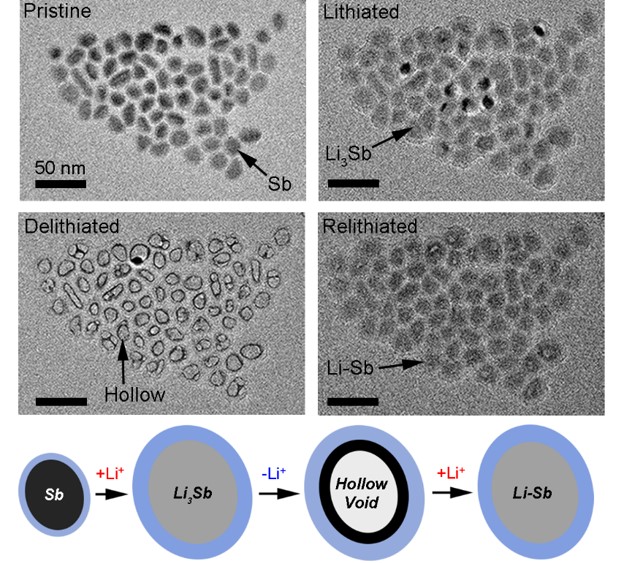
Scientific Achievement
Discovery of natural hollowing behavior of Sb nanoparticles using in situ microscopy allows for stable electrochemical cycling.
Significance and Impact
The hollowing behavior can guide alloying design that could enable materials for high-energy batteries with long cycle lifetimes.
Research Details
– In situ transmission electron microscopy (TEM) used to discover the natural hollowing behavior that small Sb nanoparticles undergo during delithiation
– Electrochemical studies show smaller Sb nanoparticles exhibited longer-term stability due to this hollowing behavior
– A chemomechanical model was developed to explain observations and understand performance dependence on Sb nanoparticle size
M. G. Boebinger, O. Yarema, M. Yarema, K. A. Unocic, R. R. Unocic, and M. T. McDowell, “Spontaneous and reversible hollowing of alloy anode nanocrystals for stable battery cycling,” Nature Nanotechnology (2020). DOI: 10.1038/s41565-020-0690-9