October 8, 2014 — More than 40 visitors with Smithsonian Associates concluded a four-day study tour Tuesday in Oak Ridge as part of a partnership formalized this summer between Oak Ridge National Laboratory and the Smithsonian Institution.
Smithsonian Associates is an educational and membership division of the Smithsonian, and members learned about the history and modern-day missions of Oak Ridge in a series of tours and meetings from Saturday through Tuesday. Their agenda included the American Museum of Science and Energy, Y-12 National Security Complex, ORNL’s Historic Graphite Reactor and ORNL facility tours led by researchers in areas such as 3-D printing, supercomputing and climate modeling.
The group included electrical engineers, novelists, lawyers, former Air Force personnel, counterterrorism workers and historians. Some had been to ORNL before.
Don Baker spent his childhood in the Oak Ridge area when his father worked at Y-12. For two months in 1970, Darrel McIndoe called ORNL home while he was in the Air Force. And Cheryl Bolen visited ORNL while completing research for a novel related to the U.S. electrical grid.
For others, the visit was a new experience. While the Manhattan Project history was a draw for many, ORNL’s current research was the appeal as the tour progressed.
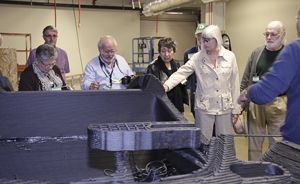
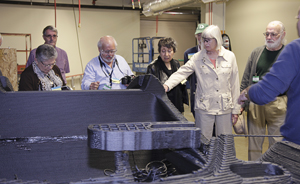
Among the highlights for the group were ORNL’s Maximum Building Energy Efficiency Research Laboratory, where researchers study the efficiency of buildings by examining building equipment and appliances and heating, ventilation and cooling systems, and ORNL’s Manufacturing Demonstration Facility, where researchers and staff just worked on a 3-D-printed car that has garnered national attention.
“Some parts, particularly the additive manufacturing, were absolutely fabulous,” said David Lengyel after a visit to the Manufacturing Demonstration Facility.
When the Smithsonian Associates advertised the tour it sold out in less than two weeks, with almost half the tickets gone on the first day. Participants expressed an overwhelmingly positive and impactful experience at the laboratory.
“I think this whole trip has been fantastic,” said Miriam Schottland. “I want to come back.”
“The enthusiasm of the people we met and talked to was incredible,” said self-proclaimed “historical, museum-geek” Bob Stern, adding, “We didn’t have nearly enough time.”
“There’s a synergy at ORNL that makes the sum greater than the parts,” said Bill Keene. “I would sign up again.”
While discussions are under way about future tours, no dates have been finalized.
The Smithsonian is the world’s largest museum and research complex, consisting of 19 museums and galleries, the National Zoological Park and nine research facilities. There are more than 500 Smithsonian staff scientists, augmented by an equal number of fellows and hundreds of international collaborators who conduct research in field stations and laboratories on all seven continents and serve as national and international experts in a wide scope of disciplines.
ORNL is the largest science and energy national laboratory in the Department of Energy system. ORNL’s scientific programs focus on materials, neutron science, energy, high-performance computing, systems biology and national security.
UT-Battelle manages ORNL for the Department of Energy’s Office of Science. The Office of Science is the single largest supporter of basic research in the physical sciences in the United States, and is working to address some of the most pressing challenges of our time. For more information, please visit http://energy.gov/science/. —Chris Samoray