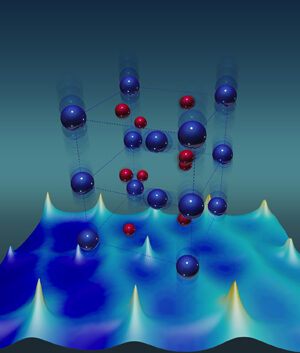
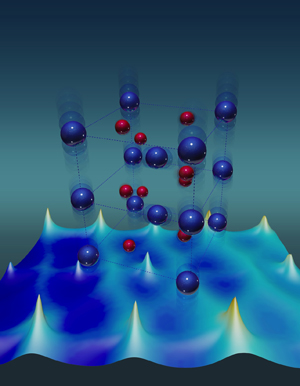
Neutron and x-ray experiments, coupled with large-scale first-principles calculations have revealed the origin of the metal–insulator transition in vanadium dioxide, an intractable question in phase stability for more than 50 years. When heated to just above room temperature, the material undergoes an abrupt transformation from an electrical insulator to a conducting metal that is driven by remarkably large atomic vibrations (phonons). This discovery provides the first complete description of the thermodynamic forces controlling the large physical changes. VO
functional applications under development range from energy-efficient smart windows to ultrafast field-effect transistors.
The fundamental work enabled a comprehensive examination of the structural and dynamic changes in VO2 as the lattice transforms from an insulator to a metal, and quantitatively established that the transition is driven by the large entropy of low-energy phonons in the metal, rather than by strong electronic correlations as commonly assumed. More broadly, this insight into how atomic vibrations control properties in transition-metal oxides is needed to predictively improve the performance of many other functional materials, including colossal magnetoresistors, superconductors and ferroelectrics.
J. D. Budai, J. Hong, M. E. Manley, E. D. Specht, C. W. Li, J. Z. Tischler, D. L. Abernathy, A. H. Said, B. M. Leu, L. A. Boatner, R. J. McQueeney, and O. Delaire, “Metallization of vanadium dioxide driven by large phonon entropy,” Nature (2014). doi:10.1038/nature13865
For more information