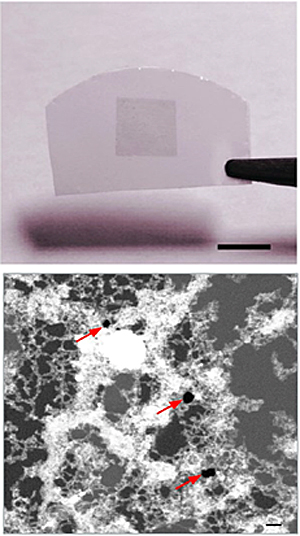
We report graphene composite membranes with nominal areas more than 25 mm
fabricated by transfer of a single layer of CVD graphene onto a porous polycarbonate substrate. A combination of pressure-driven and diffusive transport measurements provides evidence of size-selective transport of molecules through the membrane, which is attributed to the low-frequency occurrence of intrinsic 1-15 nm diameter pores in the CVD graphene. Our results present the first step toward the realization of practical membranes that use graphene as the selective material.
Significance:
Graphene, with its atomistic thickness and remarkable properties, is an ideal material for next-generation membranes with high selectivity and permeability. However, experimental measurements of ionic and molecular transport through graphene membranes have so far been limited to extremely small microscopic areas. Here, we experimentally investigate the transport of ions and molecules across a single layer of large-area CVD graphene transferred to a porous polycarbonate track etch (PACT) membrane support.
Research Details:
- ShaRE Capability: Nion UltraSTEM operated at 60kV, which is below the threshold voltage to induce damage in graphene.
- Through measurement of diffusive transport and STEM, we show that the CVD graphene contains a low frequency of intrinsic holes that permit the selective transport of molecules. The measured permeability is consistent with predictions of continuum theory.
For more information, please contact Juan-Carlos Idrobo, [email protected].
S. C. O’Hern, C. A. Stewart, M. S. H. Boutilier, J-C. Idrobo, S. Bhaviripudi, S. K. Das, J. Kong, T. Laoui, M. Atieh, and R. Karnik, “Selective Molecular Transport through Intrinsic Defects in a Single Layer of CVD Graphene,” ACS Nano 6 [11] 10130–10138 (2012)