Scientific Achievement
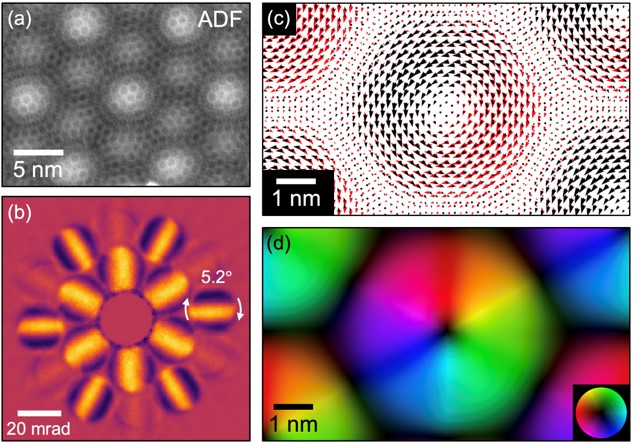
A 4D-STEM technique was developed for probing pm-scale, in-plane lattice distortions and for averaging out-of-plane interlayer spacings in stacked and twisted 2D materials.
Significance and Impact
This technique will provide a better understanding of the link between the physical and electronic structures of quantum materials.
Research Details
– The phases of interference fringes in overlapping Bragg disks were used to map pm-scale in-plane lattice distortions in few-layer graphene with nm-scale resolution.
– The interference fringe rotation was used to measure the average interlayer separation of the material.
– Paired DFT calculations and 4D-STEM simulations were used to explore the limits of the technique.
M. J. Zachman, J. Madsen, X. Zhang, P. M. Ajayan, T. Susi, and M. Chi, “Interferometric 4D-STEM for Lattice Distortion and Interlayer Spacing Measurements of Bilayer and Trilayer 2D Materials,” Small (2021). DOI: 10.1002/smll.202100388