A soldier returning from war who has lost a leg could lead a more active lifestyle with the help of Measurement Science and Systems Engineering Division’s Boyd Evans and John Mueller, who are perfecting a portable, wearable system to measure walking patterns that can be applied to real-world activities in a variety of settings.
They are collaborating with Center for the Intrepid at Brooke Army Medical Center to improve prosthesis performance for young soldiers. Wounded soldiers tend to be between ages 18 and 25, need a prosthetic that will last a long time, and be active so they are putting more stress on their healthy limbs.
“Lower-leg amputees in the military population are typically young, athletic and, besides their injuries, in top physical condition,” Mueller said. “For this reason, most military patients want to remain active and in some cases return to active military duty. We are looking at how we can improve prosthesis fit, alignment, and function.”
Additionally, Evans and Mueller want to develop a gait analysis system that can be used outside of a confined laboratory setting. Typically, motion-capture gait analysis is performed in a large, multimillion dollar laboratory using controlled conditions and limited activities.
“The goal of our research is to use the recent advances made in video game technology to develop inexpensive tools for amputee rehabilitation,” said Evans. “This will allow advanced rehabilitation techniques to both be used in smaller clinics and be taken outside the clinic. The sensors we are using in our device are the same inexpensive sensors that smart phones and video game controllers like the Wii use to determine orientation. We are also developing an app-like clinical interface to monitor patient motion that will work on smart devices like the iPhone or iPad.”
To monitor the motion and force of walking patterns, Evans and Mueller are collaborating with BAMC to utilize inertial measurement units and other sensors that can be strapped onto segments of a subject’s leg, such as the thigh, calf, and foot. The data collected from the IMU transfer to a computer, and algorithms calculate the motions and forces associated with specific joints.
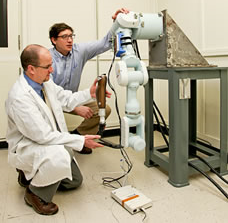
To test the effectiveness of IMUs, they use a robot leg, which has been programmed with data from a walking person. They plan on going to the Gait and Motion Analysis Laboratory at Center for the Intrepid in a few months to test their system on a human subject with a prosthetic and a healthy leg.
If the prosthesis is not fitted or aligned correctly, it could affect a patient’s walking patterns, resulting in “asymmetric” gait. These abnormal gait patterns can increase the stress on the healthy limb, leading to problems later in life such as arthritis.
“We have high expectations for this system once it is fully developed,” said Mueller. “We think it will improve the prosthetic fitting and aligning process and help lower the risk of chronic joint disease in this group of wounded warriors.”
A subset to this overall project, “Using Kinect for Xbox 360 and Computer Vision to Analyze Human Gait,” won the Siemens Competition for Math, Science and Technology in early December. The multi-camera Kinect is connected to a computer that uses body-tracking algorithms to measure how different parts of the leg move when someone’s walking. Summer interns Cassee Cain and Ziyuan Liu, who worked with Evans and Mueller, received the top Siemens team award for their project.
Evans and Mueller ‘s work represents an overall collaboration with Otto Bock Healthcare and Center for the Intrepid. Also representing MSSED, Randy Lind is developing an advanced platform to measure the forces associated with motion, and Nance Ericson and Ethan Farquhar are integrating the entire system to incorporate wireless data collection.