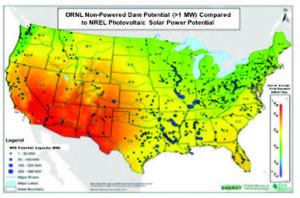
In a study of the energy-producing potential of untapped US dams, Oak Ridge National Laboratory (ORNL) researchers found that 54,000 dams not currently used to generate power have the capacity to generate more than 12 gigawatts, enough to power more than 4 million homes.
ORNL and Idaho National Laboratory researchers conducting a hydropower resource assessment for DOE calculated that the 100 dams with the highest energy potential could generate 8 gigawatts of power. The top 10 power-generating dams are along the Ohio, Mississippi, Alabama, Tombigbee, Arkansas, and Red rivers.
Equipping existing dams with power-generating plants avoids additional environmental impacts because the dams are already operating. Additionally, installing hydropower won’t change the timing of flows released from the dams.
“Most non-powered dams and potential capacity can be developed outside of critical habitat, parks, and wilderness areas,” said Environmental Sciences Division’s Brennan Smith, ORNL water power program manager. “Most of today’s large dams that aren’t generating power are used for navigation and flood control, but they have the potential to act as a renewable energy source.”
ORNL found that hydropower energy is available in areas that are not rich in wind or solar power, such as the Ohio River Valley and the Southeast.
To determine the energy potential of non-power generating dams, ORNL researchers used data from the US Geological Survey and the Army Corps of Engineers to map stream networks, dams, and stream flows. Through geospatial processing techniques, ORNL researchers were able to overlay the mapped data and collectively define energy potential at each site. The flow and elevation difference of the dam determined the power potential and allowed researchers to compute how much energy the dam could produce.
Now that researchers have quantified the potential energy of non-power generating dams, the next step will be to figure out how much it will cost to build these hydropower plants.
“The high-value opportunities for development are likely to be at large dams operated by the federal agencies,” Smith said. “The private sector can work with these agencies to develop projects that provide additional energy for the nation’s electric power systems.
For an interactive map of dams in the U.S. with the potential to produce more than 1 megawatt of power, see http://energy.gov/articles/powering-america-s-waterways.
Reference: U.S. DOE. 2012. An Assessment of Energy Potential at Non-Powered Dams in the United States. Budget Activity Number ED 19 07 04 2. U.S. Department of Energy Wind and Water Power Program.