Origin of nanopores in graphene-based carbon materials
Share
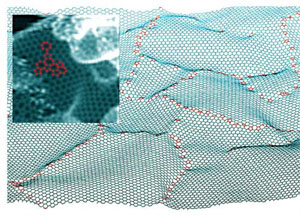
The hexagonal lattice of coplanar carbon atoms interrupted by interconnected 5- and 7- atom defects (marked in red) is clearly resolved in ADF STEM image of nanoporous carbon. The corrugated structure generated by atomic level simulations contains random sequences of topological defects identified in the electron microscopy image.
Aberration-corrected low voltage scanning transmission electron microscopy combined with simulations shows that nanoporous carbons are comprised of wrinkled, defective sheets of graphene, arising from the presence of correlated 5- and 7- fold defects that buckles the sheets creating porosity. Nanoporous carbons are of remarkable scientific interest for their high surface area and large internal porosity, which are attractive features for numerous applications ranging from hydrogen or natural gas storage, gas separation and purification through molecular sieving, and electrochemical energy storage in supercapacitors. Here it is shown that the wrinkled, one atom-thick graphene sheets in nanoporous carbons frequently contain large domains of correlated topological defects in the form of 5- and 7-atom rings. Combined results from atomic resolution electron microscopy and molecular dynamics simulation show that non-hexagonal defects in graphene sheets give rise to sheet corrugation, affecting the stacking of graphitic layers and determining macroscopic properties such as surface area, pore volume distribution, gas adsorption capacity and molecular sieving selectivity. Understanding the origin of the porosity will make it possible to tailor future properties through selective processing and doping.
Junjie Guo, James R. Morris, Yungok Ihm, Cristian I. Contescu, Nidia C. Gallego, Gerd Duscher, Stephen J. Pennycook, and Matthew F. Chisholm, “Topological Defects: Origin of Nanopores and Enhanced Adsorption Performance in Nanoporous Carbon,” Small (http://dx.doi.org/10.1002/smll.201200894)