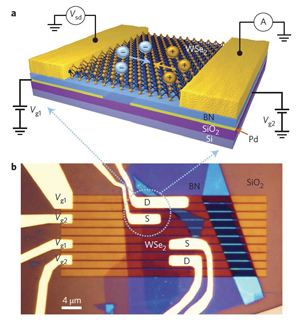
Light emitting diodes (LEDs) with improved efficiency have been realized using monolayers of WSe
carefully cleaved from high-quality bulk single crystals. This new development has the potential for applications in novel optoelectronic devices, such as on-chip lasers. The high optical quality of WSe
produces electro-luminescence with 1000 times less injection current, and 10 times smaller linewidth than found in other semiconductor materials used in LEDs, such as MoS
. Because of the large carrier effective mass and reduced screening in two dimensions, electron-hole interactions are much stronger in WSe
monolayers than in conventional semiconductors resulting in better optical properties. In addition, the large spin-orbit coupling in WSe
provides a connection between spin, charge and lattice degrees of freedom that can be used to access novel quantum ground states when the crystals are doped with magnetic atoms. These results were made possible by collaborations between Oak Ridge National Laboratory and the University of Tennessee that grew and characterized high-quality bulk crystals of WSe
, and the University of Washington and other collaborators that fabricated and studied the electro-optical properties of the monolayer devices.
J. S. Ross, P. Klement, A. M. Jones, N. J. Ghimire, J. Q. Yan, D. G. Mandrus, T. Taniguchi, K. Watanabe, K. Kitamura, W. Yao, D. H. Cobden, and X. Xu, “Electrically tunable excitonic light-emitting diodes based on monolayer WSe2 p–n junctions,” Nature Nanotech. 9, 268 (2014). doi:10.1038/nnano.2014.26
For more information