Graphitic layers suppress the coarsening of single-atom catalyst
Share
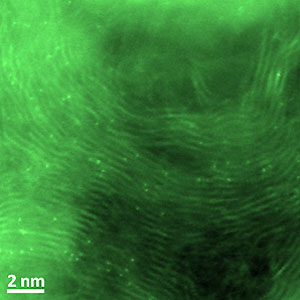
A high density of single niobium atoms (bright dots) trapped in graphitic layers
Niobium atoms can be stabilized in graphitic layers, and the resulting carbide complex exhibits higher catalytic activity compared to commercial platinum nanoclusters. This stabilization of single atoms overcomes the known problems of coarsening and cost encountered with the alternate approach of noble-metal sub-nanoclusters, which also exhibit excellent catalytic activities. In fact, small particles usually coarsen during the catalytic reaction process and this decreases their performance. Using scanning transmission electron microscopy (STEM) combined with simulations, defect-rich graphitic layers are shown to effectively trap catalytically active single niobium atoms in onion-like carbon shells. This not only enhances the overall conductivity for accelerating the exchange of ions and electrons during the oxygen reduction reaction process, but also suppresses the chemical/thermal coarsening of the particles. Theory calculations reveal that this structure produces a redistribution of d-band electrons and becomes highly active for O2 adsorption and dissociation. This study thus presents a new approach for stabilizing metallic single atoms and sub-nanometer clusters, and opens up the possibility for developing highly efficient and durable electrocatalysts.
Xuefeng Zhang, Junjie Guo, Pengfei Guan, Chunjing Liu, Hao Huang, Fanghong Xue, Xinglong Dong, Stephen J. Pennycook, and Matthew F. Chisholm, “Catalytically active single-atom niobium in graphitic layers,” Nature Communications, doi: 10.1038/ncomms2929 (2013).